
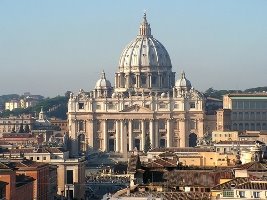
Roman Catholicism: Initial Thoughts

For several years now I have been involved on a small level in the controversy known as the “Federal Vision.” I agree with most Federal Vision men on their theology and understanding of what the reformers taught, as well as changes that need to take place in reformed theology. Because of my association with these men, my views have frequently been labeled Roman Catholic. This caricature has been thrown around often enough that I felt I needed to learn what the Roman Catholics really taught. So over the last three years I have read the Roman Catholic Catechism (hereafter RCC) twice. Lest you think this is a minor feat, since you are only acquainted with the Westminster Confession or the Three Forms of Unity, the RCC is 688 pages long. I read the English version from 1994 that was officially approved by Pope John Paul in 1992. As far as I know this is the official document containing Roman Catholic doctrine. There has been a 2nd edition published in 1997, but it is essentially the same. Thus I am not guessing at what they believe, I am quoting what they believe. I am going to write some posts on what I read commenting as I go on the problems with various doctrines.

Before beginning the posts it seemed wise to declare my perspective on the Roman Catholic Church.

1. From 1517-1845 or so the dominate position of the reformed world was that Roman Catholic baptism was valid. This means there was enough of the true Church within Rome for her baptisms to be accepted by Protestants. This changed as a baptistic worldview came to the forefront in the late 1800s and on into the 20th century. I still consider a RC baptism valid, that means I still consider the Roman Catholics a church.

2. However, there are many problems in the Roman Catholic Church and these problems are not minor side issues. Christ, the Gospel, and the Scriptures are obscured and marred by various traditions that are not in the Scriptures or worse contradict the Scriptures. I will be looking primarily at these errors in hopes of teaching those who read this and clarifying my own thoughts on some Roman Catholic doctrines. In my opinion several of the doctrines, in particular the doctrine of Mary, put the validity of Rome as a true communion on thin ice.

3. Finally, these posts are not meant to gloss over the heaps of errors currently buzzing around in Protestant Churches. We have so many planks in our eyes that it is hard for us to see clearly what is wrong with the Roman Catholic Church. I just finished reading John Calvin’s The Necessity of Reforming the Church. What struck me about the book was how many of the problems in the Roman Catholic Church of the 1500s are now found in the Protestant churches in the 21st Century. They are dressed in different clothing, but take off the garb and underneath we look a lot like Rome prior to the Reformation. How different is the marketing of the Gospel in contemporary churches from what Rome was doing to fund St. Peter’s Basilica? Rome obscured the true meaning of the Supper behind superstitions. We obscure it by infrequent celebration and often not even on Sunday morning. Rome had her priests and Pope. We have our celebrity pastors who sell millions of books and invite presidential candidates to debate at their churches. To quote Douglas Wilson, “Making all necessary adjustments for the changes in time and place, the modern evangelical Church, eyes fat as grease, bastion of born againism, is fully as corrupt as the Church prior to the Reformation.” (A Primer on Worship and Reformation, p. 9)

Hollow Trees, Fruitful Branches

As a pastor, one question that must be grappled with is how to deal with people who want to join your church. How does a pastor decide whether to allow some to join his church or not? What is necessary to consider someone a Christian? Must a person go through a new members class to be brought fully into the church? Denominations also add a level of difficulty to the situation.

All those who are baptized in the Triune name are part of the Church, unless they have been excommunicated. It does not matter whether someone is a Methodist or Roman Catholic or Lutheran, their baptism has brought them into the Body of Christ. However, there are entire denominations on the edge of apostasy. For example, the PCUSA as well as the Episcopal Church are well on their way to being hollow in their confession of Christ. There are also several denominations that are solid in teaching biblical, orthodox truth. Notables are the PCA and the Southern Baptists. One may think that I would treat someone from a Episcopal church differently than a person from a PCA church. They would be wrong in this assumption. Even if the denomination is hollow, there may be members within it who are fruitful. In fact, they may be seeking a transfer in membership for that very reason.

The individual’s situation and the specific church they are coming from are what need to be considered. We should not say someone is coming from the Episcopal Church, but rather they are coming from Redeemer Episcopal Church across town. The denomination should not determine their entrance into our local body. But still the denomination matters because doctrine matters. If a Roman Catholic wanted to join our church, I would want to sit down with them and make sure they understood the differences and were willing to submit to the elders. The same goes for any other church where the teaching varies widely from what we believe. I think this is why the specific church matters a lot. While a denomination is drifting from the faith, there are often good ministers and churches within the denomination. A pastor should not assume that just because a person is coming from a corrupt denomination that they have received corrupt teaching.

Here is the process I think should be used when someone seeks to join a specific local body. The person/family should be invited over to the pastor’s house, so the pastor can get to know them better. Depending upon the size of the church this could be done by an elder. Contact should also be made with the church they are transferring from to make sure the person is not under church discipline. If the person is not under discipline and they have been baptized in the Triune name, then they should be transferred in without delay, perhaps taking some vows to submit to the elders and promote the peace and unity of the church. A new members or catechism class is fine, as long as it is not a requirement to join. Failure to agree on all the details of theology, immaturity, or general prickliness are no reasons to keep someone from joining your church.

Thoughts on Planting a Liturgical Church

Garrett Craw is a pastor in Santa Clarita, CA. He has been posting some of his thoughts on church planting. His church is much like mine, liturgical and reformed. His insights have been helpful. Here are the links to all eight of his thoughts on church planting.

Thought 1
Thought 2
Thought 3
Thought 4
Thought 5
Thought 6
Thought 7
Thought 8

John Knox Reincarnate

Gene Robinson is an open sodomite, who also happens to be a bishop in the Episcopal Church. This past weekend he was preaching a sermon in England. All of the sudden, John Knox showed up and gave him the what for.

http://news.bbc.co.uk/2/hi/uk_news/7504472.stm

It is hard to hear everything the man is saying, but the word “repent” is given prominence. Also, note his age. To add to the fun, the man was escorted out of the church and then rode away on a motorcycle. I hope we will see more of this in the coming years as people get fed up with the heresy and sin put forth by those who lead the church. Enjoy!

A Highway to Hell?

The Pew Forum recently published the findings of a survey of over 35, 000 religious Americans. We all know the problems with these types of polls, how the questions can be manipulated and the answers vague. Still the findings were interesting and should give us pause as to what type of culture we are living in, especially what kind of church culture. Time Magazine has an analysis of the report. I wanted to comment on a couple of findings from the survey.

First, I found it surprising that Catholics were so weak in numerous areas. For example, 79 percent of Catholics surveyed believe many religions can lead to God. Also, “More than most groups, Catholics break with their church, and not just on issues like abortion and homosexuality.” Only six in 10 Catholics described God as “a person with whom people can have a relationship” — which the church teaches — while three in 10 described God as an “impersonal force.” In case you missed it, that means 40% of Catholics surveyed find God unknowable. Add to this that 25% of Catholics surveyed express some doubt about the existence of God at all and a bleak picture begins to develop. I guess I expect this from liberal mainline denominations like the PCUSA and the Methodists, but I did not expect this from Catholics.

Second, only 14% of those surveyed said that religion is the main influence on their politics. The reason for this is not hard to find. Politics is religion for most evangelical Americans. Notice this quote from news story, “But it [the report] also showed support across religious lines for greater governmental aid for the poor, even if it means more debt and stricter environmental laws and regulations.” While this may at first appear insignificant, it is a disturbing quote. It shows a shift in allegiances. In Scripture, caring for the poor is the task of God’s people. We are called upon to care for widows and orphans. We are called upon to serve our communities. It is one thing for pagans to expect the government to do the work of the Church. It is entirely another for Christians to expect the government to do the work of the Church. The American empire has replaced the Church as the hope for believers. Our messiahs wear three piece suits and placate us with soft words. And worst of all we listen and invite them to speak at our churches. Christ has everything to do with politics, but unfortunately instead of making Christ Lord of politics, we have made politics Christ. We have replace the Word made Flesh, with an idol of stone. Anyone who knows their Bible can see that this will end badly.