
Christ is the Central Content of the Sacraments

the-lords-supper

I really enjoyed Pierre Marcel’s book The Biblical Doctrine of Infant Baptism.  Even if you are already convinced of the paedo position it is worth your time. He does an excellent job of explaining what sacraments are, the covenant is, and how that impacts us, the church, and our children. One thing that stuck out to me was the emphasis he put on the Word.  He does not minimize the sacraments. It is clear they are powerful signs and seals of God’s covenant. But he is clear that the Word is the priority over the sacraments. I plan on putting up quite a few quotes from the book. Here is the first. The title of this section in the book is the same as the title of the blog post. All punctuation, spelling and italics are his.

To sum up, the internal matter of the sacrament, the inward grace which is signified and sealed, is Jesus Christ and His spiritual riches-the covenant of grace, justification by faith, remission of sins, faith and conversion, communion with Christ, etc. It is Christ, whole and entire, in all His fulness and with all his riches, according to His divine nature and His human nature, with His person and His work, in His state of humiliation and in His glorification. Christ and Christ alone is the “heavenly thing” signified in the sacrament -Christ who, with all his benefits and blessings, is the Mediator of the covenant of grace, the Head of the Church, the Yea and Amen of all God’s promises, the content of His Word and of His Testimony-Christ: Wisdom, Justification, Sanctification, and Redemption of believers, Prophet, Priest, and King, through whom alone God conveys all His grace, who remains the same yesterday and to-day and for ever. Jesus Christ, He who was, and who is, and who is coming, is the truth of the sacraments without whom they are nothing, just as He is the truth of the Word.

There is thus not a single benefit of grace which might be missing from the Word and communicated in a special and particular manner to believers through the sacraments. There is no special baptismal grace, nor a special eucharistic grace. The content of the Word and of the sacraments is exactly the same. Word and sacraments contain, present, and offer the same Mediator, Jesus Christ, the same covenant of grace, the same benefits, the same communion with God, the same redemption.

Marcel did not believe in paedo-communion, but I wanted to take this quote and apply it to that issue. I believe paedo-communion is Biblically defensible for various reasons.  Here is what I mean by paedo-communion: covenant children are welcome at the covenant meal.

I wanted to pull out two thoughts from this quote as it relates to paedo-communion.  First, there is nothing magical about the Lord’s Supper. In other words, the covenant child who is receiving the Word of God in worship and at home is receiving Christ. Taking the Lord’s Supper will strengthen that faith, strengthen his bond to the church, and confirm the Word. But taking the Lord’s Supper will not give him something he is not already getting. Christ comes to us first and foremost through the Word. If the Word is there then Jesus is there in His entirety. 

On the flip side, if we give our children the Word of God why shouldn’t we give them the Lord’s Supper? If I allow my child to participate in worship as one of God’s covenant children,  treat them as belonging to the covenant, quote to them the promises of the covenant, encourage them to believe those covenant promises, trust their heavenly Father and obey Him then why shouldn’t they have the covenant meal which presents to them the same promise the Word does: Jesus in his entirety?

Sacrificing Like Christ

thorns

We must be careful when we are talking about being like Christ. There are ways we can and cannot be like Jesus. His work on the cross was unique. His death atoned. His sacrificed took away our sins. We also must guard against the temptation to view Christ as just a good example and nothing more. Yet we are supposed to look like our Lord in a secondary way.  Ephesians 5:1-2 say this: “Therefore be imitators of God, as beloved children. And walk in love, as Christ loved us and gave himself up for us, a fragrant offering and sacrifice to God.” While our sacrifices do not atone we are supposed to show our love for others by sacrificing for them. Here are four ways we can know that we are learning to sacrifice like Christ. What do we sacrifice? It is rarely our lives. What we give up is time, money, energy, and often our own dreams and desires.

1. We are learning to sacrifice without resentment. Sacrifice with bitterness is not sacrificing like Christ.  This ties in closely with #2.  Often we are not sacrificing, but we are buying people with our good deeds. When we do something nice and there is no payoff we get bitter.

2. We are learning to sacrifice when there is nothing in it for us. If we have a “I do this for you, but you will do something for me” mentality we are not sacrificing like Christ. Too many of us function on debt/payment system. When we sacrifice for someone we are putting them in our debt and they now owe us. This is not like Christ. This is a great danger for parents who often give to their children in the hopes that the children will give back to them as well as spouses who sacrifice for each other, but often in hopes of repayment.

3. We are learning to sacrifice for those who do not deserve it.  Let’s state the obvious: Jesus gave for those did not deserve, you and me.  Go and do likewise. So often, before we decided to sacrifice for someone, we evaluate them and weigh them in the balance. Do they really deserve this? It is a great twisting of grace to only give to those who we think deserve it.

4. We are learning to sacrifice with joy.  A sacrifice that is sour is a sacrifice tainted with sin.  This does not mean we ignore the difficulty of sacrificing for others. (See Jesus in the garden.) But it means that we should be glad to lay down our money, time, energy, and dreams for those around us. It is better to give than receive.

Fighting Through Many Difficulties

knight-1

We often believe that things should be easier than they are. This leaning of our hearts is made worse by the constant bombardment from the media telling us that our lives are too hard and if we buy what they are selling then our lives will be easier.The basic presupposition in the news and media is that we all deserve to be wealthy, well-fed, healthy, and happy. This assumption is so ingrained in our thinking that it is rarely challenged. While we may mock Joel Osteen we all think like him. We expect God to give us “Our Best Life Now.” When God gives us difficulties and hardships we groan and rebel crying, “This is not how it is supposed to be.”

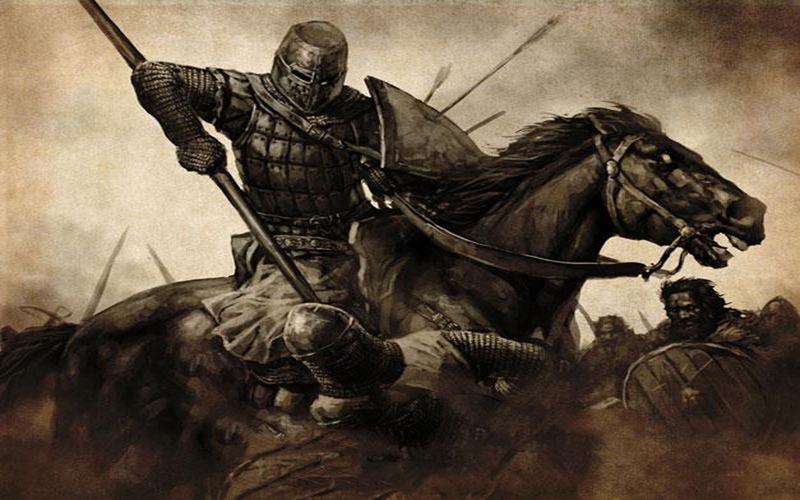
Christians should know better. Our Lord’s life was not easy. We are called to a daily death (Luke 9:23). We are to embrace this death looking to the joy set before us (Hebrews 12:2). We are to pour ourselves out for others, whether that is children, spouses, flocks, or neighbors. As believers we should expect things to be hard. But this is not enough. If we bear our burdens, trials, and difficulties like melancholy martyrs led to the stake, then we have missed the Gospel. The Gospel says to die is to live and to be poured out is to be gathered back up again. This means the difficulties of life are not burdens, but rather treasures. Jesus tells us to rejoice in persecution (Matthew 5:11-12). Paul tells us in Romans 8:18 that our sufferings do not compare to the coming glory.  When Christ calls us to our daily cross let us go with singing and joy remembering that our labor is not in vain in the Lord (I Cor. 15:58). This is not an encouragement to pretend that pain is not pain and hard things are not hard. Things are hard and it is okay to say so. Just read the Psalms. But it is an encouragement to remember that glory comes through death. Too many Christians think glory comes through making their life easy and comfortable. They assume that if things are hard then something is wrong.  Continue reading

Weariness and Rewards

Running Shoes

Weariness is the enemy of all noble things. G.K. Chesterton
Let us not become weary in doing good. Galatians 6:9

Surveying the cultural landscape a Christian is easily discouraged. All around, where there once stood truth, now there are lies. How did we reach a place where sodomy is right, where nine men decide that killing children is not murder, where you can decide whether you want be a boy or a girl despite what your plumbing is, where we have two politicians running for president who not just bad politicians, but wicked people who in previous generations would have been laughed off stage or thrown in prison, and in the church numerous denominations have already jumped off the cliff and others are sliding that way? How did we get here?

There are numerous factors in this decline. The failure of Christians to preach the Lordship of Christ, the lack of church discipline, and the fact that many believers send their children to government schools are some of the factors contributing to the current state of the American church. However, as I read the above quote by Chesterton a new reason for the decay struck me. Many have become weary.

I have nine children. I understand weariness.  It is hard to press forward day after day, week after week, month after month, year after year, decade after decade. Too many Christians have become tired. I have friends who havegiven up. Oh, they still call themselves Christians, but the truth is they stopped fighting the good fight long ago. Pastors became tired of preaching Christ and Him crucified, so they began to preach Jesus the great therapist who will cure all your ills. Some became weary of the scorn of the scientific establishment, so they accepted evolution and higher critical theories of the Scriptures.  We became weary of raising children for the Kingdom, so we sent them somewhere elsewhere or didn’t have them at all.  We became weary of shepherding the flock, so now we buy them and keep them like so many customers.  We became weary of looking like bigots and prudes so our sexual morality has eroded. There were not great theological shifts for many, no great changes in doctrine. Instead the world wore us down. Continue reading

Sermon: With His Own Blood, Hebrews 9:1-14

Several people really enjoyed this sermon. One friend commented that it was one of the clearest gospel presentations she had heard. That was encouraging.  The point is pretty simple: only the blood of Jesus can cleanse our conscience, the inner man. Or to put it negatively, our works cannot make us acceptable to God.