
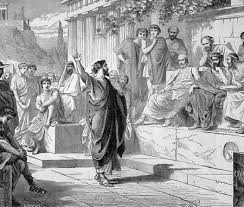
Carving a Middle Road: Two Types of Preaching

One of the best things about Herman Bavinck’s book Saved by Grace is how he unfolds the impact various theologies have on preaching.  In the latter section of the book he notes that there are two main types of preaching, evangelistic and ethical preaching. We could rephrase this as preaching which assumes the listener is not a Christian and preaching which assumes they are. He then goes on to give the dangers when one type of preaching dominates congregational preaching.

Evangelistic preaching-Preaching Only to the Unsaved

When this method under the blessing of the Lord has brought someone to conversion, it separates that person from the environment wherein God has place him, and it has no eye for the apostolic exhortation that each one after his conversion should remain in the calling entrusted to him. This approach appreciates the first part of Jesus’ word: preach the gospel to every creature; but it neglects the second part: teach the nations that are made my disciples to keep all that I have commanded. This method does lay the foundation but does not continue to build on that foundation, and therefore runs the danger that the entire foundation, constructed with little effort out of unstable materials, will later be washed away by the storms of unbelief and superstition. 

Preaching that always assumes unbelief never builds on the basics. A church like this eventually atrophies. I have seen Baptist and Presbyterian churches where the sum of every sermon is, “Believe in Jesus.” The most pressing matters of the day are rarely dealt with from the pulpit. The Biblical text is often twisted to fit an agenda.  Many texts are avoided all together. The saints do not become strong. Assurance of salvation is hard to find as all members walk around with a “?” on their foreheads.

Ethical Preaching-Preaching Only to the Saved

This approach to preaching leads people gradually to confuse believing the confession with confessing belief, yielding a situation of dead orthodoxy that is satisfied with intellectual assent to doctrine and that bothers itself very little with disposition of the heart and purity of life. Such an approach teaches church members to think and talk this way: Are we not members of the church? Did we not receive baptism when we were young? Did we not make a profession of faith, and have we not participated in the covenant meal? Just as Israel exalted itself because of its descent from Abraham and because of the temple of the Lord in its midst, so too many New Testament church members often build their hope for eternity on outward ecclesiastical privileges in which they share, and they surrender themselves to a false security. But the Word of the Lord testifies against all of this; it is not the one who says, “Lord, Lord,” but the one who does the will of the Father who will enter the kingdom of heaven. 

As the revivalistic, seeker sensitive model described above weakened, so the ethical model of preaching began to ascend. People are assumed to be regenerate. Instead of a “?” they all have a big “E” on their heads for elect. This leads to presumption and often a stagnate Christian life.

Bavinck goes on to write that it is hard to carve a middle road between the two but it must be done.

The difficulty of including both of these components in preaching and keeping them in balance is recognized by every minister of the Word according to his capacity. 

In a healthy church there will be sermons or portions of sermons that exhort the members to examine themselves to see if they are in the faith and sermons or portions of sermons that build on the foundation of Jesus Christ. There will be the Gospel proper, “Believe in the Lord Jesus Christ” and what I call the broad Gospel, “Walk worthy of your calling.” Finally, he notes that understanding the covenant allows a pastor to do both:

Congregational preaching ought never to omit the serious summons to faith and repentance. Proceeding on the basis of the covenant does not exempt the preacher from that, but rather it is precisely this that obligates him to issue such a summons…for no matter how inestimably great the blessings already are that God bestows upon us when from our birth we are included in the covenant, born in a Christian church to Christian parents, baptized with holy baptism and nurtured in a Christian family-all these blessings are still not enough. Each person is confronted with the obligation of personal, saving faith; only one who believes in the Son has eternal life… The preacher’s sermons should connect God’s work that has preceded, to the gifts and blessings He has bestowed in His covenant, in His Word, and in His baptism. His sermons should continue building upon the foundation God Himself has laid, but then should also continue warning of the need for self-examination, so that people do not deceive themselves for eternity. Biblical sermons seriously summon church members to faith and conversion both initially and continually, for only those who believe will be saved. 

How one applies Bavinck’s insight will vary from church to church and even from phase to phase of church life. In a large church with dozens of visitors each Sunday exhortations to examination may be more frequent.  A smaller body of believers where each member is known by the minister will mainly need discipleship.  The type of preaching will also vary from text to text. Some texts are more evangelistic and others less so. I would argue that most regular Sunday morning preaching should be discipleship based, Bavinck’s second type of preaching. But even in those situations the call to faith and trust in Christ should be regularly given. And sometimes when it is, a baptized Christian believes for the first time.

Book Review: On Preaching

On Preaching: Practical Advice for Effective PreachingOn Preaching: Practical Advice for Effective Preaching by H.B. Charles, Jr
My rating: 4 of 5 stars

A very solid book on the nuts and bolts of preparing to preach and preaching. There were several themes that stuck out. First, he emphasized prayer throughout the book, which was an encouragement to me. We are to be men of prayer and you can tell for him prayer is not on the edges, but at the center. Second, he focused on clarity. Be clear he said over and over again. This emphasis on clarity shows he is interested in feeding the sheep instead of impressing the sheep. Third, I liked his idea of writing out a sermon manuscript, but taking nothing into the pulpit except his Bible. I have never done that, but I will try it in the future. Finally, he has several chapters that other books on preaching don’t, such as how to be a guest preacher, avoiding indecent illustrations, how to prepare a sermon calendar, and how to be an associate minister.

There were a few drawbacks. He does not spend very much time on the body of the sermon. He probably felt this was covered in more in-depth books on preaching. At times, he is a cliched. He also repeats himself a bit, though my guess is that this comes from many of the chapters originally being blog posts.

For a young preacher like myself this book was helpful in keeping the target, faithfully handling and preaching God’s Word, in my sights.

View all my reviews

Gay Marriage, Civil Disobedience, and the Christian Future

This was originally posted at Kuyperian. 
“Power is in tearing human minds to pieces and putting them together again in new shapes of your own choosing.” George Orwell, 1984
Jack Phillips is a Christian baker in Lakewood, Colorado. In 2012 Jack Phillips refused to make a wedding cake for a gay couple. This couple then reported him to to Civil Rights Commission. A lawsuit followed. The judge ruled against Jack Phillips. The Civil Rights Commission has now come back with its ruling, which consists of three parts.
First, Jack Phillips must change his store policies immediately and begin make wedding cakes for gay couples.
Second, his entire staff must attend training on Colorado’s anti-discrimination laws and agree to abide by them.
Third, for the next two years he must submit quarterly reports to show that he has not discriminated against customers based on their sexual orientation.
Jack Phillips might appeal the decision, but it is hard to see how anything will change.
Here are few quotes.
The Commission chairwoman, “You can have your beliefs, but you can’t hurt people at the same time.”
The ACLU attorney, “Religious freedom is undoubtedly an important American value, but so is the right to be treated equally under the law free from discrimination…Everyone is free to believe what they want, but businesses like Masterpiece Cakeshop cannot treat some customers differently than others based on who they are as people.”
The judge, ”At first blush, it may seem reasonable that a private business should be able to refuse service to anyone it chooses. This view, however, fails to take into account the cost to society and the hurt caused to persons who are denied service simply because of who they are.”
Let the tearing begin.
1984
So how should we live in this country where the rejection of God’s created order is law? How should we live when those in power want to reshape our minds in ways contrary to Scripture? Here are a few thoughts in no particular order.
First, we are past the live and let live stage (if one ever existed).  The sodomites are not saying, “We will live this way and you live that way and we can coexist.” They are demanding that we publicly accept their sins. Anyone who believes that we can all just get along will soon wake up to find their position overrun.
Second, they will come for our children. How long before the State demands that home schooled children and children in Christian schools get “sensitivity training?” If they can make a business owner train his employees why not a principle his students and teachers? Why not a parent their children?
Third, Christians in all walks of life should expect more traps. Think of Daniel 6. Pastors should expect homosexuals to visit their congregations to see if they are preaching against homosexuality. Christian business owners should expect homosexuals to come in and see if they get turned away.  Christian politicians should expect homosexuals to try and out them in some way. I am not encouraging hand wringing, just open eyes.
Fourth, human sexuality, including male-female roles, marriage, procreation, female ministers, sodomy, abortion, divorce, rape, pedophilia, sexual abuse, transgender, etc.  is the battle line right now in America. There are other issues, but few are as pressing as this one. Therefore this is where we must fight.  I am not saying this is all we talk about. And I understand that there are many ways we fight against this wave of immorality, such as love our wives, worship the living God, evangelize our neighbor, teach our children, live holy lives, and preach the Word. But let’s not miss the obvious: one way we must fight is by saying clearly and without apology what God’s Word teaches on these subjects.
Fifth, any pastor or public Christian leader who refuses to speak against these things is a coward. Again, I am not saying this is all we to talk about or that we speak with malice . But our stance on sodomy, and issues related to it needs to be clear and public.  It is our duty to stand in the line of fire, to preach the Word, and to rally God’s people around the truth. A pastor or Christian public leader whose stance on the above issues is vague or unknown is not being a faithful shepherd.
Sixth, pastors and Christian leaders need to teach their people what godly civil disobedience looks like. There is a lot of freedom in how we resist the State’s growing power.  But the time for abstract theological discussion about civil disobedience is passing quickly. We must study God’s Word, meditate on it, pray through it, and study our fathers in the past to learn from them. Then we must teach our people the proper responses to the State. What can we do as Christians? Is there any place to take up arms?  (Maybe those debates about the Revolutionary War and the Civil War are not so arcane after all.) Should we march? Should we keep our businesses open even if there is the threat of police action? Should a Christian business owner reject a homosexual job applicant? What should we do if they come for our children?  What if they come for our guns? Should Christians accept government money in any situation? What should Christian schools do if they are commanded to teach that homosexuality is fine? How should Christian magistrates function? Should Christian soldiers get out or resist from within? Pastors and churchmen should be leading the charge in answering these and other questions.
Seventh, Christians should expect to lose money, businesses, tax breaks, jobs, etc. for taking a stand against unbiblical sexual practices. The Church and her members need to be prepared for this. We should think long term in our financial dealings so that we can “have something to give him who has need.” (Ephesians 4:28)
Eighth, churches should pray for leaders in corporate worship. I Timothy 2 is clear on this point. Do we pray for our leaders? Do we pray for new, righteous leaders to rise up? Do we pray that God would cast down those who hate his Church? Do we pray for pagan leaders to repent and turn to Christ? Do we pray for that we may lead a quiet and peaceful life in all godliness (I Timothy 2:2)? Do we pray for our leaders by name?
Ninth, Christians need to be known as a peaceful people. Psalm 120:7 says, “I am for peace, but they are for war.” We should be the ones who long for peace. This does not mean we are quiet about everything. Nor does this mean we compromise the Gospel to be at “peace with all men” (Romans 12:18).  But it does mean we are careful about what battles we fight. Young people, of whom I am one, especially need to hear this.  We tend to think that every sin is worthy of fire bombing.  But we need to make sure we are hitting the big targets and not spending days chasing one lone enemy through the forest.
Tenth, we must not despair. Jesus sits on throne. We should act from faith, not fear.  We should not be anxious, worried, fretful, fearful, depressed, or discouraged. Our Lord told us this would happen. Our Lord told us to rejoice when we are persecuted.  The Church will march on. We have a job to do. Let us do it with joy in the Holy Spirit, faith in Christ, and dependence upon our Father. In the end, all will be well.

We are Not Here to Retell the Story

It has become a fad to see preaching as primarily as a retelling of the Gospel. Pastors are story tellers. We stand up each Sunday and retell that old, old story. This approach is used in some gospel-centered churches and missional churches But it is also a common approach in more liturgically and sacramental churches like mine. We are past the fire and brimstone preachers of yesteryear. We are past Calvin calling out the Libertines (and the Pope and the Anabaptists) and Chrysostom calling out women who beat their maids. We are past Jonathan Edwards declaring with authority that Judgment Day is coming.  Now we believe that just retelling that wonderful story is enough. We are afraid of being moralists. We are dread that awful phrase, “legalism.” So we pander in our sweaters telling the world that Jesus died and rose again, but never telling them to repent. We never tell them that the sexually immoral do not inherit the Kingdom. We just keep telling the story and trust the Holy Spirit to apply the Word. We have the sword, but instead of using it we just remind people that it is there and they should really think a lot about cool it is and how it gleams in the warm sunlight.

There are several problems with this approach.

First, the examples of preaching and exhortations to preaching in the Bible are not like this. Jesus’ Sermon on the Mount (Matthew 5-7) is not simply a retelling of the Old Testament. It is a proper interpretation and extended application of the OT. Paul often takes OT passages and tells us what they mean and how we are to apply them. For example, in I Corinthians 10:1-13 he does not just tell us what happened to Israel. He tells what it means and how it applies to the lives of those at Corinth. He doesn’t just say, “Look the Israelites grumbled.” Or in I Corinthians 15 he doesn’t just say, “Look Jesus rose from the dead. Remember that.” When Paul tells Timothy what to do he does not say, “Tell the story.” He says, “Reprove, rebuke, exhort with all patience.” (II Timothy 4:2)

Second, if all we need is the story, then we don’t need preachers. We need readers. Reading the text and going over it is not preaching. Preaching is the text interpreted and applied with authority to the congregation. This is what Moses, Isaiah, Jesus, Peter, Paul, and John did. This is a preacher is to do.

Third, this approach may leave the congregation feeling fed, but it does not actually feed them. This type of preaching can leave a warm glow. The pastor talks about Jesus, grace, the forgiveness of sins and the glory of redemption. But he never exhorts, warns, rebukes, challenges. So people don’t grow, but they leave thinking they have.

I am not saying there is never a place for preaching on grace and forgiveness. Obviously there is.  And pastors are to leave their people with a proper view of Christ as welcoming repentant sinners. But pastors are not here to retell the story. We are here to interpret and apply the story. We here to tell our people what the Bible means, why it means what it means, and what our congregations should do about it. In doing this we are not being arrogant or proud, we are fulfilling our office. If we aren’t doing that then we are not doing our job.

Book Review: Preaching

Preaching?: Simple Teaching on Simply PreachingPreaching?: Simple Teaching on Simply Preaching by J. Alec Motyer
My rating: 4 of 5 stars

Good solid book on preaching. It is almost like having your grandfather walk you through a preaching course on your back deck. It had a great conversational tone that gave it warmth. I really enjoyed his focus on variation and personality. He gives solid instructions without saying, “You must do it this way.” The last chapters on the pastor’s personal walk with Christ were excellent. He shows clearly how the private life of the minister is the source of his public life.

View all my reviews