
Theses on Worship: Part IV

Here is more from Jim Jordan’s book Theses on Worship

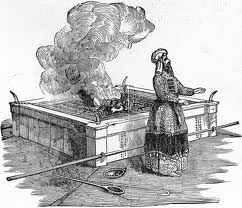
1. The Psalter should be woven into the warp and woof of worship. 
“If we drift from the psalms, the warchants of the Prince of Peace, we shall drift into an easy and lax piety.  The inner warfare will be deemphasized, and the warfare for the world will disappear…The fact of the matter is that the present generation of American Christians will either learn to sing psalms, or it will die…God wrote the psalms, and they are the most appropriate form of and school of praise.  Dare we offer Him anything else?”

2. Worship is sacrificial.
“In the broadest sense, sacrifice is not a negative, but a positive thing. When God sacrifices us, He transforms us into new creatures. He takes us apart and puts us back together again as newer, better, more glorious, more transfigured, more powerful servants. It is only because of sin that this act of God’s is painful to us…Worship is to be a transforming, transfiguring event in our lives, a time when God sacrifices us, and fits us for His presence and his Kingdom.”

3. Worship is covenant renewal.
“Human beings were created in covenant with God, and we are always covenant-beings…one implication of [this] is that doing worship self-consciously as a covenant renewal is good for us.  We were made to be patterned covenantally, and so the best form of worship is the one that conforms to the covenant pattern.”

Here is Jordan’s description of a covenant renewal worship service:
1. God calls us.
2. God glorifies us.
3. God instructs us.
4. God feeds us.
5. God commissions us.

Theses On Worship: Part III

More from Jim Jordan on worship.

1. Love makes things beautiful
In this section Jim Jordan argues that love for God will cause us to beautify the various parts of worship. This includes our dress, the Communion table, the pulpit and the entire sanctuary. One area that needs a lot more work by conservative, protestants is how to make the places we worship sanctuaries where the beauty of God and his world is seen.  Too often our sanctuaries feel like a shopping mall or a theater.  If there are decorations they are usually not linked with anything in the Bible. One positive sign has been the emergence of cloth banners in churches. They perform the same service as stained glass windows did in early periods. They make the sanctuary beautiful and tell of who God and/or what he has done.

2. Worship should be dramatic
“Worship is drama…The liturgy is theater performed by all of us before God.  Thus, entering, kneeling, standing, clapping, eating, etc. are all aspects of drama.  We don’t need to have little skits during the sermon in order to have drama in worship! After all, what on earth is more dramatic than being called into God’s presence, kneeling to confess our corporate sinfulness in Adam and our actual daily sins, being sealed again into His community by absolution, standing to praise Him with vigor, hearing the ‘orders of the Day of the Lord’ from the Commander in Chief, giving Him our gifts, sitting down to dine with Him and being sent out, commissioned by Him to service?  It shows great poverty of thought to imagine that we need to have skits in the sermon, when we have these dramatic treasures to employ.”

3. Worship comes in the context of death.
“The Bible says that the gospel comes to those who all their lives are subject to the fearfulness of death (Hebrews 2:15)  Death is the primordial punishment and the last enemy. Death suffuses human life, rendering it cheap and miserable.  This is a fact that no amount of positive-thinking Pelagianism can make go away…It is the pastoral ministry of the Church and only the Church that can deal with the fact of death…The fact that the gospel comes in the pastoral context of ministry in the face of death is absolutely destructive to two of the most virulent forms of modern gnosticism.  It is destructive to ideology, the promotion of Christianity as a set of ideas to be implemented through a crusade.  It is also destructive to the ‘prosperity and happiness’ message so often promoted by the media-gnostics over our airwaves…The gospel is good news for real people hurting in real life situations. That is why modern gospel songs are so inadequate. They present a ‘happy gospel’ without the context of pain, enemies and death.

Take Up and Read: Thursday Edition

Here is a link to all the Desiring God Pastors Conference messages. They are all worth your time. I found Pastor Piper’s on J.C. Ryle to be excellent.

If you are looking for a crash course on the conservative view of the Constitution, check out these lectures from the president of Hillsdale College, Dr. Larry Arnn.

The Elephant Room 2 has changed some things in reformed world.  Thabiti Anaybwile discusses what has changed and what has not changed. His words are wise. I especially enjoyed these three points: Theological depth is critical, We need a practical understanding of repentance and Our cooperation can have a liberalizing tendency. It is a shame we leave events like these behind so quickly. In our world, lessons are disposable. No doubt, by this time next year the Elephant Room 2 will be forgotten, along with the lessons God intended for us to learn from it.

Here Toby Sumpter explains how corporate salvation and individual salvation fit together. This paragraph was fantastic:

One conclusion to draw from the inextricable connection between our individual salvation and our corporate sharing of salvation is a pastoral one: to call sinners to repentance is necessarily to summons them to care about the people sitting next to them. To call a man, woman, or child to believe in the Lord Jesus Christ is to call them to begin to love their neighbors, brothers, sisters, parents, and children. This is witnessed in the household conversions in the New Testament, and meshes with the big picture.

How often do we view repentance only as a turn away from sin towards God?  But if what Jesus says in Matthew 22:37-40 means anything then repentance also involves turning in love towards our neighbors.

Finally, Eric Metaxas gave a speech at the national prayer breakfast. With President Obama in the audience he winsomely decried false Christianity, declared Christ to be the one way and compared abortion to the Nazi Holocaust. I did not agree with every jot and tittle, but in our age it is a rare man who will speak with such boldness on a very public platform.  Here is an article at nationalreview.com describing the event. Here is the video of Metaxas giving the speech. He begins speaking around the 34 minute mark. Here and here are links to Metaxas’ two biographies, one on Bonhoeffer and one on Wilberforce.

Take Up and Read: Wednesday Edition

Coal is close to the heart of many West Virginians. Since  I make my home in West Virginia this photo gallery of coal operations around the world was interesting.
 
Here is Pastor Voddie Baucham on his invitation to Elephant Room 2, why he declined, the subsequent fallout and how race can push out orthodoxy.We need men like Pastor Baucham because he can confront black pastors who are heretics without race clouding the discussion.

In 2005 Peter Enns wrote a book that toed the line about Biblical inerrancy. Many felt the book opened the door to the Bible being fallible, though this may not have been Enns’ intention. This eventually led to him leaving Westminster Seminary. Now he has written a book claiming that evolution and Christianity can coexist. (All you “there is no slippery slope” people need to take note.) Peter Leithart, who is a friend of Enns, takes him to task here and here.  (Call it Peter vs. Peter brought to you by Peter.) The view that the early chapters in Genesis are not historical has gained considerable traction in “evangelical” circles lately. Tremper Longman is another man who has denied that Adam was a historical figure. This battle is not going away any time soon. I am grateful for Peter Leithart and the CRE (my denomination) which hold strongly to six-day creation. 

Kevin DeYoung on why we should still have an evening service. Our church currently has only one per month. But DeYoung’s points are worth thinking about. One question he doesn’t address is “why has the church dropped the evening service?”  The answer to this will tell us something how thinking in the church has shifted in last couple of decades. Has it dropped because our society has changed so much that getting to church twice on Sunday is now almost impossible?It is a logistical shift with people living further away from the place they worship?  Or has it dropped because we have substituted discussion groups for preaching?  Or has it dropped because we have become a lazier society that doesn’t really want to show up at church twice in one day? It would be interesting to know why people stopped coming to the evening service and why churches stopped having them.

Here and here are some wonderful quotes from Doug Wilson’s lectures at the Desiring God Pastor’s Conference. He is my favorite teacher/pastor on the home and pastoral ministry.

Take Up and Read: Thursday Edition

Here are some links I liked from this past week:

Pastor Doug Wilson continues to tell readers what to expect at a CRE church. Here he talks about wine in communion. Here he briefly describes our musical tastes.

Pastor Kevin DeYoung explains why a church must be unapologetically theological.  In other words, every church should love theology.

Pastor Randy Booth tells his readers how to talk behind his back.

Brian Croft has a several good posts on having a multi-generational church and the blessings that come with it. Here are post 1, post 2, and post 3.