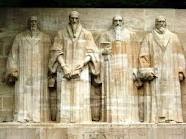

Take Up and Read: Reformation Sunday Edition

Here are some links I enjoyed as Reformation Sunday approaches.

George Grant lists his favorite Martin Luther quotes. I would have enjoyed at least one quote with some spicy language. But the ones listed are very good.

Steven Lawson has been doing a series of blog posts at Ligonier about various reformers. Here are the posts on John Calvin, Heinrich Bullinger, William Tyndale, Ulrich Zwingli and Martin Luther

At christianaudio.com you can get Martin Luther in his own words for free this week. For those of you who only know Luther because you have heard about him or sung “A Mighty Fortress” this book would be a good introduction to some of his thinking.

Also at Ligonier you can download for free R.C. Sproul’s new book for children entitled “The Barber Who Wanted to Pray.” It tells the story of why Luther wrote his classic on prayer called “A Simple Way to Pray.”

Finally, one of the great contributions of the reformers was on the subject of justification by faith. Uri Brito, a pastor in Florida, has posted some thoughts by Peter Leithart on what justification is.

Soli Deo Gloria

Book Review: The Shaping of the Reformed Baptismal Rite

The Shaping of the Reformed Baptismal Rite in the Sixteenth CenturyThe Shaping of the Reformed Baptismal Rite in the Sixteenth Century by Hughes Oliphant Old
My rating: 5 of 5 stars

Very, very good. I loved this book, even though I couldn’t translate all the German or Latin. There are two things I love about H. Old’s writing.

First, he always tells you less than he knows. When you read him there are paragraphs which are little glimpses into the history of a subject or a person. You know that there are large amounts of information he left out. You wish you could sit down with him and have him expand on those paragraphs.

Second, he teaches theology through history. You think you are reading history, but when you are done your theology has morphed. He doesn’t do this in an underhanded way. He simply shows how what men do and do not do in history flow from their theology. This book was superb in explaining that the reformers theology of baptism flowed directly from their theology of grace.

Two topics I enjoyed from this book. First, he explained how the Anabaptist opposition helped clarify the reformers’ position. Second, I enjoyed the different types of baptismal prayers he quoted.

My theology and practice of baptism was clarified by this book. I am very grateful for H. Old’s labors and scholarship. He has wielded a tremendous influence on my view of liturgy, sacraments and the Church.

View all my reviews

Take Up and Read: Thursday Edition

Here are some links worth reading:

Trevin Wax describes how he wishes an interview about homosexuality would go. It is not perfect, but it is better than what you usually get. If you want to see how these interviews usually go see Al Mohler’s dissection of Joel Osteen’s interview with Piers Morgan.

Here is a good article by Mary Kassian on why gender-inclusive Bibles, including the new NIV, are bad for women and the Church.

Douglas Wilson has some short posts on what you can expect to find at a CRE church. Here is post 1 and post 2. 

Here is why Tim Keller is slowly, but surely, losing my respect. I know it is not him presiding over the wedding service. But to have a woman officiating at wedding ceremony for your church in ministerial garb is a clear sign that compromise has occurred.  A picture is worth a thousand words.

Finally a good short word by Pastor Randy Booth on how falling off a cliff usually begins with small excuses and compromises.

Book Review: Biblical Eldership

Biblical Eldership: An Urgent Call to Restore Biblical Church LeadershipBiblical Eldership: An Urgent Call to Restore Biblical Church Leadership by Alexander Strauch
My rating: 4 of 5 stars

An excellent basic overview of the office of elder. The strength of the book is the exegesis of various passages, such as I Timothy 3, 5 and Titus 1 on the office of elder. I also appreciated his sections on Acts 15, James 5:13-18 and Hebrews 13:17. I did not necessarily agree with all his conclusions, but his work on these passages provided a lot of food for thought. I would recommend it to anyone interested in being an elder.

I had two questions that he did not answer well. First, how much of Paul’s ministry is paradigmatic for the elder? For example, I and II Corinthians contain several passages describing Paul’s ministry. Do these passages have anything to say to the elder? Strauch did not answer this question very clearly. The reason I bring it up is because if Paul’s ministry is a paradigm for an elder then it would seem to imply two types of elders or two offices (minister of the Word and ruling elder). Normally, a ruling elder who works a job 40-50 hours a week cannot be doing what Paul did.

Second, how much of Paul’s instructions to Timothy and Titus, outside of the passages specifically about elders, apply to elders? Here I am asking the same question as the one above. If Timothy and Titus are paradigms for elders then there would appear to be two offices or at least two very different duties within the same office. A man who works 40-50 hours and is a ruling elder on the side is going to have a difficult time using Timothy or Titus as a paradigm. Some of this is implied in I Timothy 5:17-18.

My point is that whether you call a position “Three office” or not, if you use Paul, Timothy and Titus as your paradigm there is going to be at the very least a functional difference between the man who devotes himself full time to the ministry and the ruling elder. I do not think Strauch addressed this issue very carefully or clearly. By focusing on the passages that just specifically address elders, he left a lot of relevant passages on the cutting room floor.

View all my reviews

Why Some Reformed Are Not Reformed

Carl Trueman laments that many of those who call themselves reformed are reformed on the doctrines of grace, but not reformed on other issues.  Here is a quote from an article he recently wrote:

“The problem with the way `Reformed’ is often used today is that it divorces certain things (typically the five, or more often, four points of Calvinism) from the overall Reformation vision of pastoral care, church worship, Christian nurture and all-round approach to ministry.  The Bible becomes sufficient for the doctrines of grace; but what works, what pulls in the punters, becomes the criterion for everything else, especially ecclesiology and pastoral practice.

One question I have, as the reformed movement grows, is can it continue to hold to the doctrines of grace, while rejecting the reformers “overall vision of pastoral care, church worship, Christian nurture and all-around approach to ministry?”  My gut says no.