Further Thoughts on Colossians 2:20-23

Therefore let no one pass judgment on you in questions of food and drink, or with regard to a festival or a new moon or a Sabbath. These are a shadow of the things to come, but the substance belongs to Christ. Let no one disqualify you, insisting on asceticism and worship of angels, going on in detail about visions, puffed up without reason by his sensuous mind, and not holding fast to the Head, from whom the whole body, nourished and knit together through its joints and ligaments, grows with a growth that is from God. If with Christ you died to the elemental spirits of the world, why, as if you were still alive in the world, do you submit to regulations—“Do not handle, Do not taste, Do not touch” (referring to things that all perish as they are used)—according to human precepts and teachings? These have indeed an appearance of wisdom in promoting self-made religion and asceticism and severity to the body, but they are of no value in stopping the indulgence of the flesh (Col 2:16-23). ESV

This passage could be referring to Jewish OT law, although the phrase “human precepts” in Colossians 2:22 would seem to contradict this. But even if it is referring to OT law, my point [from this blog post] is not weakened, but strengthened. If OT laws are useless in fighting against the flesh, how much more useless are non-biblical food laws?

Men and women love to believe that doing hard things to their bodies will make them more holy. It is a constant temptation. If I exercise, eat right, take these supplements, don’t do this, and do do that I will not just be healthy, I will be more righteous. The words used in Colossians 2:23 indicate a hard, severe approach to the body. Again arguing from the greater to the lesser, if whipping oneself and starving oneself will not help with the indulgence of the flesh then how will abstaining from soda or cigarettes?

Paul is not saying we cannot abstain from certain foods. He is just saying abstaining will not make you more righteous. Many will agree with this in theory. But in practice food restrictions or the idea that eating a certain way is healthier easily becomes a way of looking down on other people. We make a choice for our family and it quickly becomes the right choice for every family.

The last phrase of Colossians 2:23 is especially strong. These things, despite the appearance of holiness, wisdom, and self-control are of no value against the indulgence of the flesh. They are ways of looking holy, but not actually being holy.

We all like to look wise and holy. Food restrictions help us keep up appearances. But they are of no value against sin: fornication, uncleanness, passion, evil desire, covetousness, lying, anger, malice, blasphemy, and filthy language (Colossians 3:5-9).

So make the food choices you think are best, but don’t turn them into signs of holiness. And make sure you spend a lot more time fighting lust, anger, bitterness, pride, and covetousness than you do fighting your waistline.

Related Blog Posts
Quit Fussing
Back to the Shadows
Doctrines of Demons
Basics of Mercy Ministry

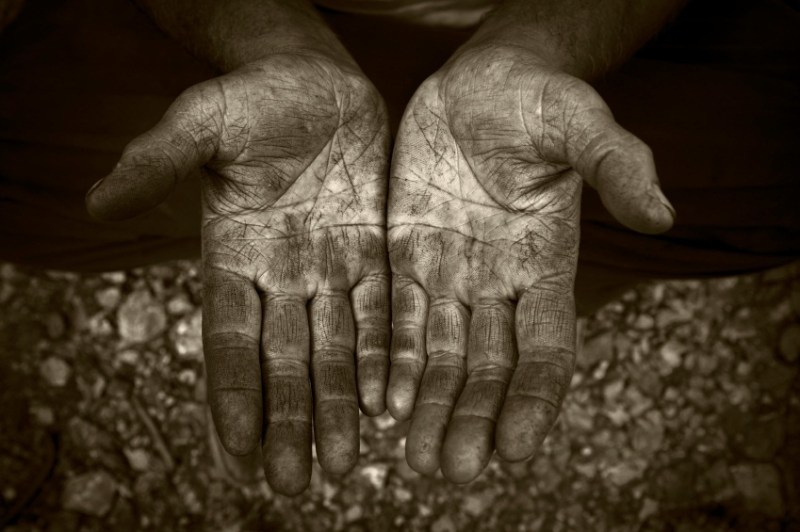
Poor Hands.jpg

What is mercy ministry? For my purposes in this post it is primarily meeting someone’s physical needs whether those needs are immediate and temporary or more long term. This list is not comprehensive.

1. There can be no mercy ministry without understanding the mercy Christ has shown to us in His death. Martin Luther’s last recorded words were, “We are all beggars, this is true.” We must understand this if we are to do mercy ministry well. None of us deserve the air we breathe, the water we drink, the food we eat, much less the salvation freely given  to us by our Savior. Without this foundation our mercy ministry will be a sham. It will driven by guilt, pride, or our weak attempt to manipulate others. But when we understand Christ’s mercy shown to us beggars then we give freely, generously, and graciously.

2. Mercy ministry is not the job of the deacons. It is the job of the church.  Deacons are facilitators and they take care of more dramatic needs as well as needs that stretch out over time. But mercy ministry is for the whole church. If a church ordains deacons so they might do mercy ministry while the congregation watches that is a guarantee that mercy ministry will not happen.

3. Physical needs matter. Whether or not someone has food or clothing matters. If someone cannot make a house payment that should concern us. There are hundreds of verses in the OT talking about the poor, needy, weak, widows, and orphans. We tend to view physical needs in a different category from spiritual needs. But God loves our bodies. One day he will resurrect the bodies of believers to glory. His Son took on a body. Helping the poor is not preaching the gospel. But it is a consequence of preaching the gospel and those who claim to believe the gospel and don’t help those in need are lying (I John 3:16-18).  Continue reading

Doctrine of Demons: Further Thoughts on I Timothy 4:1-5

I Timothy 4:1-5 is one of the strongest arguments for all foods being open to all men.

People can fall away from the faith because of the false teaching discussed in this passage.  Paul is not expressing some minor disagreement between friends. People can

This false teaching is the teaching of demons and deceitful spirits. These “principalities and powers” will work through insincere liars. These liars are insincere because they give the appearance of rigorous Christian discipline, but are really not Christians at all.  In other words, these teachers are the pipelines through which the demons get their lies into the ears of the people.  This is one of places where the curtain is pulled back and we see who is really pulling the strings of these false teachers.

These teachers have their consciences seared. Seared could mean branded, as in marked by the Devil. Or it could mean cauterized, as in unable to discern right from wrong. The latter is more likely. These men’s consciences have been “smothered and eventually silenced.” Their dead consciences keep them from seeing or understanding that they are influenced by demons.

There are two things expressly forbidden by these false teachers: marriage and food. These are two actions, sex and eating, are at the very center of human existence.  Without either one the human race would perish. They have from the earliest times been subject to man-made regulations. Often celibacy was held up as higher and holier than marriage. And often men severely restricted their diets because they thought certain types of food was evil.

John Stott notes that there are two ways creation has been sanctified or set apart for man to use. First, all things created by God were good so that we might enjoy them and give thanks to Him. The things created are to be received with thanksgiving. This is stated twice, at the end of verse 3 and the beginning of verse 4. No doubt there is an echo of Genesis 1 here where God declares over and over that “it was good.” (Genesis 1:4, 10, 12, 18, 21, 25, 31) Second, it is made holy by the Word of God and prayer.  That is when we remember what God’s Word has said and offer thanks for what he has done. The first is objective. God made all things good. The second is subjective. We are to set them apart by recalling the doctrine of a good creation and giving thanks for it.

Verse 4 is strong. Everything was good. Nothing is to be rejected.  Paul wants to make sure nothing created by God is ever called taboo.

These verses tie together very strongly redemption and creation.  A failure to appreciate creation could lead men to “fall away from the faith.”  While a proper understanding of creation means we give thanks because we believe and know the truth. And we consecrate all created things by remembering what Scripture says and by giving thanks.

The Whole World Our Banqueting Table

The first six items are here.

7. It is a doctrine of demons to encourage abstaining from foods because you think they are sinful. I Timothy 4:1-5 are very clear on this particular point. Teachers were saying you were unholy if ate certain foods and had sex. Paul denounces these men and calls them the voice of demons. This passage is emphatic and strong. Nothing is to be refused if it is received with thanksgiving. If someone doesn’t want to eat meat that is fine. But if they don’t eat meat or anything else because they think it is evil, sinful, or less holy they are teaching false doctrine. All things can be eaten, provided they are sanctified by the Word and prayer.  Colossians 2:20-23 and I Timothy 4:1-5 are foundational texts for understanding what use food has in our lives.

8. A lot of Christians use “the body is the temple of the Holy Spirit” argument from I Corinthians 6:19 as an argument for healthy living. However, we must remember that Paul is talking about having sex with a prostitute. So if you think drinking soda or smoking cigarettes or refusing to exercise is “defiling the temple” then you are saying that these are the equivalent of sleeping with a prostitute. Is that really what you want to say? Is that really biblical? No doubt this is in the top ten most misused verses in the whole Bible.

9. To refuse fellowship with another brother or sister over food is a great perversion of the Gospel. To divide over organic vs. inorganic, natural vs. processed, meat vs. veggies, hormone free vs. hormones, exercise vs. non-exercise, white vs. wheat, etc. is to deny Christ who has made us one body in the Spirit. We lean towards self-righteousness, which means we lean towards false lines of holiness where we are on the holy side. Food is one of the ways Satan tempts to look down on other believers. Food is not usually a barrier between churches, but it is often a barrier between Christians. We don’t put in our vision statements: “No short, bald, fat guys allowed.” But with our attitudes, who we like to hang out with, and our treatment of men and women we make it clear that thin, healthy people are preferred.

10. This one will make some people mad, but here goes. Many of the current food fads in Christendom are promoted by women. I know this has not always been the case, but it is now. Most of the best-selling “Christian” exercise books and “Christian” eating books come from women. Most of the pastoral problems about food stem from women who pester their husbands to bring up the issue to the pastor. Pastors and husbands need to teach the women in their flocks and homes a Biblical perspective on food and exercise.  I would encourage beginning with I Timothy 2:11-15.

11. It is easy in our culture to see exercise as a means of holiness. Men and women who exercise should remember I Timothy 4:7-8, which follows very closely on the heels of the I Timothy 4:1-5. Paul says that physical exercise is of little value or possibly it could be translated is only valuable for a short time. Paul is not saying exercise is wicked. But he is saying that we should keep it in perspective. Exercise is of limited value in this life and of no value for the next life.  In our sports and super model saturated world it is difficult to keep our exercise in perspective. Go without exercise for a week or a month and see what that does for you spiritually. Did you feel guilty? Do you feel less holy? If so, your perspective is off. I am not saying stop exercising. Exercise is good. But keep it in perspective and remember that it does not make you more holy.

12. Remember that our culture is obsessed with physical appearances and living a long life. Our culture spends billions each year on beauty and health, promoting items, such as tanning, implants, hair dyes, gym memberships, organic food, etc.  The world believes you will be happier if you are thin. And of course, their pockets will be fatter as well. The world wants to live forever. But for us death is gain. (Philippians 1:21) The newspapers and magazines and sitcoms are not neutral observers, but preachers for a materialistic, Godless world, where the only thing that matters is living as long as you can and being as beautiful as you can be. But for us pouring out our lives, including our bodies, is what we are here to do. (See Romans 12:1-2 and Matthew 10:38)  As Nate Wilson said, “Self-preservation is not a great virtue in [our] story.”  Do not buy into the false gospel they are preaching. Pour yourself out for those around you with little concern for self-preservation.

13. Last, but certainly not least, your view of the Lord’s Supper says a lot about your view of food. Is the Supper a banquet, where we feed upon the body and blood of Christ? Or is it a place where we do penance, hanging our heads in sorrow?  A low, somber view of the Lord’s Supper can lead to or come from a low view of the created world, including food. This is a huge topic, but a brief word will have to do.  The only place outside the Gospels where the Lord’s Supper is discussed extensively is I Corinthians 11:17-34. There the picture is not one of somberness, but of so much food and drink people were getting drunk. Paul does not tell them to tone it down. But rather he tells them to wait on each other. The Lord’s Supper is a feast. (c.f. I Cor. 5:8) Once we see that, then I Timothy 4:1-5 makes perfect sense and the whole world becomes our banqueting table.

Back to the Shadows


Food can be a source of great anxiety for Christians. Our society bombards us with what and how we should eat. Every week there is new study telling us about the evils this food or that food. How should we think as Christians when it comes to food? Below is my brief attempt at putting up some guardrails on a road where many are currently driving over the cliff. A couple of notes before I begin:

First, I know there are Christians who flaunt their freedom and eat like gluttons. I know it is possible for the fat person to look down on the thin. However, in the community I am in and the Christian world at large that is becoming less and less of an issue. The bigger issue is holiness by dieting or exercise. That is what I am addressing because that is what I see around me.

Second, each person has to make choices about how they want to eat and what they want to eat. I understand this. However, too often our choices become a source of holiness for us and a way of dividing between Christians. What we eat has very little bearing on our own righteousness and holiness and should not be a source of division in the Body of Christ.

With those qualifications out of the way, here are my points.

1. The Old Testament laws about food have been done away with. It is hard to understand what else Acts 10:9-16 along with 10:28 can mean. Any Christian who tells you, “Don’t eat pork because the Bible forbids it” has failed to understand the New Covenant and is leading you back to the shadows of the Old Covenant.

2. The Old Testament food laws were about the separation of Jew and Gentile. This is clear from Acts 10:28. The Old Testament food laws were not about health.  There are many arguments against this. God never uses this type of language. He tells them to do this because they are to be holy, separate from the nations. (Leviticus 22:26) The Old Testament dietary laws are not a manual on healthy eating. They were a reminder to the Old Testament saints that they are to be separate from the nations. With the coming of the New Covenant those OT dietary laws are broken down as God is making one new man out of two. (Ephesians 2:14-18)

3. Natural food is not necessarily healthier than processed food. In today’s culture, much of the processed food has been stripped of its nutrient value. However, it is important to not overreact. Nature is fallen just like man. There is not pristine, natural wheat. The wheat has felt the effects of sin just like we have.  Also, God put us here to take dominion. We should be trying to make the wheat better. That is what God put us here to do. Just because greedy men tear down what God has given does not mean we should just take food as it is. We were made by God to take up the things in the world and transform them for his glory. This would include wheat, cows, and orange trees.

4. The two primary food sins in Scripture are gluttony and drunkenness.  If you eat too much or drink too much alcohol then you are sinning. However, having an extra piece of pie does not qualify as gluttony, just as having two beers does not qualify as drunkenness. Gluttony, like drunkenness is not hard to spot. The verses on gluttony are few and far between, though it has always been included among the seven deadly sins. Primary verses are Deuteronomy 21:20 and Proverbs 23:19-21. The picture here is not of someone who overeats and is overweight, but of someone who leads a riotous, drunken life and squanders their money and time. (c.f. Matthew 11:19 and Luke 7:34) I am reminded of the vomitoriums in ancient Rome, where men would eat until they were full and then go throw up so they could eat some more. That is the picture of gluttony.  A fat person is not necessarily a glutton. A thin person can be a glutton.

5. Where your food comes from does not matter. As Americans we have been taught somewhere that it is our solemn duty to make sure our food does not come from a tainted source. But in I Corinthians 8:1-8 Paul says it is not a sin to eat meat offered to idols. (See especially I Corinthians 8:8) If it is not a sin to eat meat offered to idols, then it is not a sin to eat non-organic chickens, lettuce from China, and beef filled with hormones from the meat plant in Iowa. This is an argument from the greater to the lesser. If the Scriptures teach that I can buy meat sacrificed to idols, it is hard to see how it is sin to buy and eat vegetables with pesticides on them or to eat chickens that were stuffed in a small cage their whole life.

6. What you eat or refuse to eat does not make you more holy than someone else. You are not more holy because you refuse to eat white sugar or white flour. You are not more holy because you buy organic. You are not more holy because you are a vegan or drink soy milk. You are not more holy because in your Christian liberty you can eat an entire pizza. You are not more holy because you exercise. Paul makes this point in Colossians 2:20-23.  Men love to draw unbiblical lines of holiness to separate themselves from others. Paul says these false lines make us look holy and feel holy, but in end they are of no value against the indulgence of the flesh. Paul tells us where true holiness comes in Colossians 3:1-17.(See especially verses 5, 8, 12-13) If we worried more about those things mentioned in Colossians 3, sexual immorality, impurity, passion, evil desire, and covetousness, and less about what type of flour we are eating, how much fat is in our food or how much weight we put on we would be more holy.