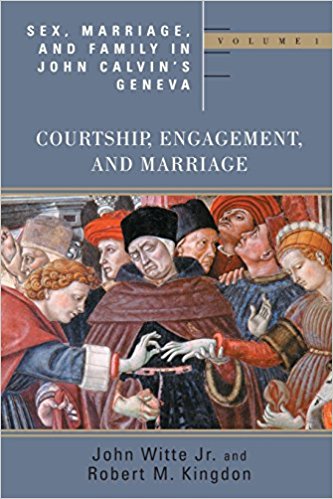
Courtship, Engagement, and Marriage in Calvin’s Geneva

Kingdon and WitteI am going to repost, with some revisions, my blog series on Kingdon and Witte’s excellent work: Sex, Marriage, and Family in John Calvin’s Geneva: Vol 1.  There were supposed to be two more volumes, but Robert Kingdon died. I am not sure the status of the next two books. We cannot nor should we adopt all the specifics of pastoral care in Geneva. However, in our age where moral formation through pastoral care is an afterthought, books like these are of great value. The sheep wander off cliffs regularly while pastors waste their time or better yet push them. This books gives a way godly shepherds cared for their sheep in the a specific time and place. And while we cannot adopt all the particulars, the principles do not change.  And the subject of marriage, children, and sex is never boring and always relevant. 

What pops in your mind when you think of John Calvin? Austere reformer? Man who had Servetus killed? A man who taught that evil, black doctrine of predestination? Or do you think of a man who protected women and children and sought to reform marriage? This latter picture is the one painted by this book. I think most people will find me weird for loving this book so much. But I did. As a pastor I am always looking for different perspectives on pastoral care. This book is a great picture of pastoral theology and care in action during a specific time period. This book is supposed to be the first of three volumes on Sex, Marriage, and Family in John Calvin’s Geneva. I sincerely hope they get the other two written. This one focused on pastoral counsel up to and including the wedding. The next volume will focus on marriage and children. The final volume will focus on divorce, desertion, abuse, and widows/widowers.

Continue reading

Three Goals of Church Discipline

More from Scott Manetsch and church discipline in Geneva.

Geneva’s ministers believed ecclesiastical discipline had three primary purposes or goals. First, moral correction helped preserve the purity of Christ’s church and protected the Lord’s Supper from being profaned. Second,  church discipline was intended to protect Christians from the bad influence of wicked people. Third, moral discipline was intended to shame rebellious sinners, thereby hastening their repentance and making possible restoration to the Christian community.

Two notes on this.

The primary goal of church discipline is always to honor Christ and his church. While we want to see sinners restored that is not the primary aim. Christ is honored when ministers consider his church, which he shed his blood for, precious enough to remove those who through heresy or wicked living flagrantly dishonor Christ. A refusal to do this is a refusal to love Jesus.

Second, the loss of shame across our society has made church discipline much less effective. Even in churches shame is considered a bad thing, something to be avoided. How can a sinner be brought to repentance without being ashamed of his actions? The only goal of discipline is not to shame a person. Nor is the shame to exceed the nature and gravity of the sin. Still, without shame excommunication loses its power. It is a terrible thing for men’s souls when they can go down the road, head held high, and join another church after having been excommunicated.

The Keys to the Kingdom in Geneva

Reformers 1

Man, am I enjoying Scott Manetsch’s Calvin’s Company of Pastors. I have decided to describe it as a pastoral theology disguised as history. Here is Manetsch’s summary of the ways Calvin and his successors believed ministers exercise the power of the keys to the kingdom (Matthew 16:19).

First, the spiritual authority to “bind and loose” was exercised in a general way when ministers preached the gospel in their sermons, announcing God’s righteous judgment upon the wicked and God’s promise of salvation to those who turn to Christ in repentance and faith. Second, the power of the keys was employed more particularly when pastors and lay elders conducted annual household visitations to examine the character and doctrine of church members, or when they admonish sinners in private conferences. Finally, ministers and elders employed the power of the keys through the ministry of the Consistory as they confronted people who were guilty of moral failure and excommunicated from the Lord’s Table those who refused to repent of their error. At each stage of discipline, church leaders needed spiritual discernment to apply the appropriate measures of rigor and gentleness to bring about the repentance and restoration of the sinner. Wise pastors, Beza [Calvin’s successor] once observed need “not only to discern the illness, but also the best medicine to prescribe, preaching the Law to the hardened, and the gospel of grace to those despairing. In brief, let us always condemn the sin, but try to save the sinner.” This was Calvin’s view as well. The power of the keys needed to be exercised with wisdom and gentleness in hopes of rescuing the sinner.  Otherwise discipline might degenerate into “spiritual butchery.”

Just a couple of notes from this paragraph.

First, church discipline is often understood only as excommunication. This is a serious mistake and fails to recognize that a majority of discipline in a church occurs from the pulpit in a general fashion or one on one either through visitation or counseling.

Second, the lost art of visitation is one of the reasons why sin among the congregation is not more quickly recognized and dealt with. Visitation does two things: it creates a stronger relationship between the minister/elders and the members so when rebuke is necessary there should already be a bond of love. And it gives the minister a chance to be in the home and ask questions about how the member is doing. If the only time a minister/elder speaks with a member is before or after a regular meeting or when there is crisis then sin will not be adequately dealt with.

Third, discipline in all it forms, preaching, private meetings, and excommunication requires great wisdom on the part of ministers. It is easy to make mistakes, especially in our age where the congregation usually does not want anyone exercising authority in their lives, whether from the pulpit or in their living room, and the pastors have rarely seen spiritual authority exercised well, if at all.

A Shield Against Doubt

I am preaching on Psalm 12 this week. Here is a quote from John Calvin on why we need to be reminded that God’s Words are true and that he “promises nothing in vain.” He is commenting on Psalm 12:7, “The words of the Lord are pure words, like silver tried in a furnace of earth, purified seven times.”

There is no man, it is true, who will not frankly confess that he entertains the same conviction which David records here, that the words of  Jehovah are pure; but those who while lying in the shade and living at their ease liberally extol by their praises the truth of God’s word, when they come to struggle with adversity in good earnest, although they may not venture openly to pour forth blasphemies against God, often charge him with not keeping his word. Whenever he delays his assistance, we call in question his fidelity to his promises and murmur just as if he had deceived us. There is no truth that is more generally received among men than that God is true; but there are few who frankly give him credit for this when they are in adversity. It is, therefore, highly necessary for us to cut off the occasion of our distrust; and whenever any doubt respecting the faithfulness of God’s promises steals in upon us, we ought immediately to lift up against it this shield, that the words of the Lord are pure.


What Traditions to Avoid

TraditionIn chapter X of his Institutes John Calvin is explaining what types of human traditions and laws should be accepted and which ones should be rejected. In section 16 of that chapter he gives a nice summary of his thought.  He asks, “What are those human traditions of all times that should be repudiated by the church and by all godly men.” He then gives a list.  First, he says,

All laws apart from God’s Word, laws made by men [that]

  • either prescribe the manner of worshiping God
  • Or to bind consciences by scruples
  • As if they were making rules about things necessary for salvation.

In other words, the Bible must dictate our worship and what is necessary to be saved. Men cannot make up a laws about worship and make those mandatory or equate them with God’s Word. Nor can man add to God’s Word what is necessary to be saved. Obviously, there is a lot more that could be said about this. He then goes on to give other practical considerations when implementing traditions in the church. What if the tradition is not doing any of the above? Is it automatically okay? Calvin says no. He encourage us to ask the following questions:

  1. Do these rules “obscure by their multitude the clarity of the gospel?”
  2. Are “they in no sense constructive but are useless and trifling occupations rather than true exercises of piety?”
  3. Are “they calculated for sordid and base gain?”
  4. Are “they too difficult to observe?”
  5. Are “they befouled with shameful superstitions?”

Of course reading this list our mind runs straight to Roman Catholicism or perhaps mega church pastors who twist the Word for financial gain. But I want to apply to the reformed world. There has been a liturgical renewal among reformed folks over the last couple of decades. This has led to a closer examination of liturgical traditions, including the church year, robes, kneeling for communion, processionals, recessionals, etc. Many of these traditions have been implemented to various degrees in reformed churches. Those of us who have adopted or are moving toward a more liturgical worship style would be wise to keep Calvin’s list in mind.   The goal of any man made tradition is to make the gospel clear, to increase piety/holiness, to be functional, to avoid all manner of superstition, and to not line the pockets of the shepherds. Too many ministers do not consider things like this carefully enough.

Here is one example where I think liturgical churches are in danger. Many liturgical churches are too complicated. And they get more complicated as time goes on. In other words, they lack functionality.  Why do we need to keep adding things to our worship service? Since what I am talking about are not Biblical commands, but rather traditions we put in place to help people worship, they are contextually dictated. We don’t live in 500 or 1500 or 1800. Some of the traditions in our worship services need to be jettisoned in order to make our worship services more functional for 21st century Americans. This is not a cry to be relevant at the expense of truth. I am not encouraging polls of unbelievers to determine what we do and don’t do. Nor do I think a modern evangelical should walk into our worship and immediately get it. But I am encouraging to us to make sure our traditions are “not too difficult to observe.”

There are other ways we can encourage superstition with our baptismal or communion practices or simply have traditions that are of little value for holiness. I am grateful for the liturgical renewal of the last few years, but that renewal is not problem free. Without restraint, caution, and wisdom some might find themselves closer to 1450 than 1550 in their approach to tradition and worship.