
Signs, Wonders, and False Prophets

Serpents in Exodus

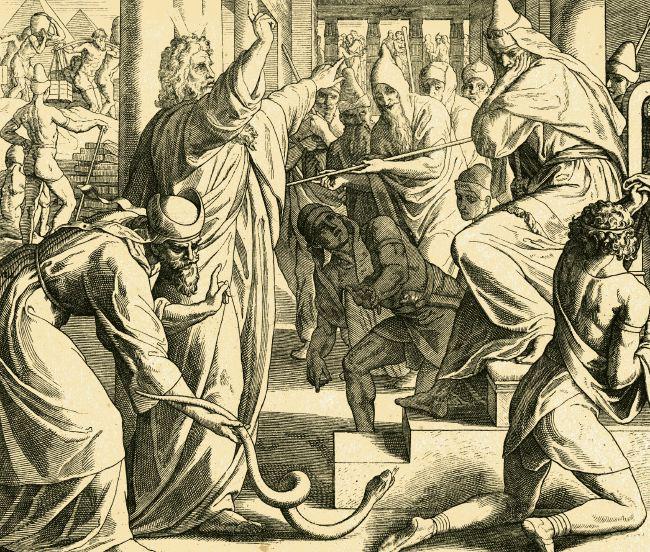
Humans like to be dazzled.  We will overlook most anything if it is spectacular. We will watch citizens eaten by lions, mostly naked girls gyrate on stage at an awards show, or an epic TV show that includes sodomy, rape, and extreme violence as long as it is amazing. We will ignore the sins of star athletes because of what they do on the field or the court. Christians are not immune to this fascination with the spectacular. We have our celebrities as well. We are always in danger of being pulled away from the truth by the dazzling deeds of the prophets. But it is important to remember that Pharaoh’s magicians could did signs and wonders too.

God knew this. In Deuteronomy 13 the Lord reminds us that signs and wonders are not a guarantee of holiness and orthodoxy.

If a prophet or a dreamer of dreams arises among you and gives you a sign or a wonder, and the sign or wonder that he tells you comes to pass, and if he says, ‘Let us go after other gods,’ which you have not known, ‘and let us serve them,’ you shall not listen to the words of that prophet or that dreamer of dreams. For the LORD your God is testing you, to know whether you love the LORD your God with all your heart and with all your soul (Deu 13:1-3).

God spoke through prophets and dreams in the Old Covenant. These prophets often used signs and wonders to prove that their words came from the Lord.  It would be easy for Israel to assume that when they see a sign, wonder, or a fulfilled prediction that the prophet is speaking for God. But there is a warning attached. It does not matter how spectacular a man’s ministry is if he encouraged Israel to “serve other gods.” The prophet in this passage can do some amazing things. He is also part of the covenant community, the people of God. He is teaching rebellion from within. He is a prophet within the church, who does signs and wonders, and claims to be speaking for God, yet he is the piper leading them to ruin.

The application of this passage to the modern world is easy. Charismatics are prone to believing a man because he can do signs and wonders. He can heal people. He must have the anointing of the Spirit. He can speak in tongues. He must be an authentic, Spirit-filled person. Many Pentecostals listen carefully to preachers who deny the Trinity. Why? Someone who denies the Trinity is not a Christian. But that doesn’t matter he can do signs and wonders.

But even outside of Charismatic circles Christians ignore false teaching if the one saying it has a spectacular ministry. While these teachers may not be speaking in tongues or healing they are still easy on the eyes and ears. Rachel Held Evans is a good example. A woman who is slowly but surely leading people to damnation, yet her teaching is ignored by many because she is so “authentic” and of course, because she is a woman. Joel Osteen comes to mind, as well as many other mega church pastors and writers, such as Robert Schuller. Their teaching is rooted in love of self. They are leading people away from God. But hey at least the journey is amazing.

And what about us reformed and evangelical folks. We like to think we above this. But we aren’t. There are men in our midst who compromise on central truths, such as the sovereignty of God and the necessity of internal, once for all, regeneration. There are men who are slowly eroding Sola Scriptura. There are men who deny the historical Adam and believe in evolution and yet they teach at our seminaries. There are men who are soft on the sinfulness of sodomy and abortion and the role of women. There are men who have covered up child abuse. There are Christian schools that allow women in their preaching classes and allow women to teach classes that should be reserved for male teachers. There are pastors who are greedy for money and power. Not all of these sins are sins of apostasy. But they are sins and major ones. Too often Christians believe these men, women, and institutions, not because of their solid orthodoxy, but because they appeal to our desire for something spectacular, something big. We like their preaching, their teaching, their style, or the fact that they have influence outside reformed circles. Whatever the reason is, too often we are blind to men and women who lead us away from God because their ministry is so great.

Deuteronomy 13 is clear. Any ministry, any preacher, any teacher, any writer, any prophet, no matter how amazing their ministry, no matter what great deeds they are doing, no matter how great their teaching, and no matter how many books they sell is to be ignored and rejected if they lead us away from the living God.


Wine to Make the Heart Glad

Wine 3

I grew up  in a Southern Baptist Church. That is enough to tell you what I was taught about alcohol. Wine, beer, and liquor of any kind was forbidden. Following college and after reading a lot of Martin Luther, I became more interested in the Biblical argument against alcohol. After some study, I came to the conclusion that alcohol in moderation is not only allowed by Scripture but in many ways it is promoted by the Bible. Wine, beer, and whiskey are good things and God wants us to drink them.

A friend of mine recently asked what I thought of the argument that the word used for “wine” in the New Testament means unfermented grape juice. This idea or something like it has been batted around the anti-alcohol circles for some time. The premise is that our wine is different from the wine in the Bible and therefore we cannot justify modern drinking of alcohol by using the Scriptures. They used grape juice. We use wine.

Let’s look at this argument. Below is one positive and one negative use of wine from each of the major sections of the Old Testament. These examples could be multiplied many times over. In every case below the Hebrew word used for wine is “yayin” and the Greek word used in the LXX, the Greek version of the Old Testament, is “oinos.” The word “yayin” occurs around 141 times in the Old Testament. “Oinos” is always the Greek word used for it in the LXX.

Pentateuch

Come, let us make our father drink wine, and we will lie with him, that we may preserve offspring from our father (Gen 19:32).

And for the drink offering you shall offer a third of a hin of wine, a pleasing aroma to the LORD. (Num 15:7)

Historical Books

And Eli said to her, “How long will you go on being drunk? Put your wine away from you” (1Sa 1:14).

And they were there with David for three days, eating and drinking, for their brothers had made preparation for them. And also their relatives, from as far as Issachar and Zebulun and Naphtali, came bringing food on donkeys and on camels and on mules and on oxen, abundant provisions of flour, cakes of figs, clusters of raisins, and wine and oil, oxen and sheep, for there was joy in Israel (1Ch 12:39-40).

Wisdom Books

Wine is a mocker, strong drink a brawler, and whoever is led astray by it is not wise
(Pro 20:1).

And wine to gladden the heart of man, oil to make his face shine and bread to strengthen man’s heart (Psa 104:15).

Major Prophets

Woe to those who rise early in the morning, that they may run after strong drink, who tarry late into the evening as wine inflames them (Isaiah 5:11).

Come, everyone who thirsts, come to the waters; and he who has no money, come, buy and eat! Come, buy wine and milk without money and without price (Isa 55:1).

Minor Prophets

Awake, you drunkards, and weep, and wail, all you drinkers of wine, because of the sweet wine, for it is cut off from your mouth (Joe 1:5). [This verse is interesting because the Hebrew has two words “yayin/wine” and “asis/new wine.”  But the Greek version (LXX) uses “wine/oinos” for both words.]

Then Ephraim shall become like a mighty warrior, and their hearts shall be glad as with wine. Their children shall see it and be glad; their hearts shall rejoice in the LORD (Zec 10:7).

There are many more verses I could use to prove my point.  Wine in the Old Testament referred to a drink that could get you drunk, but was also a good thing that could be used in moderation, was part of the worship of God and of God’s blessing on his people. Like most things in this world it is not forbidden, but we are commanded to use it with self-control.

The second most common word for wine in the Old Testament is “tirosh.” It is used around 38 times.  Tirosh was grape juice at an early stage of fermentation. In the ancient world keeping grape juice from fermenting was difficult, if not impossible. “Tirosh” was not as intoxicating as “yayin.” However, it could still intoxicate. This is clear from Hosea 4:10-11

They shall eat, but not be satisfied; they shall play the whore, but not multiply, because they have forsaken the LORD to cherish whoredom, wine, and new wine, which take away the understanding (Hos 4:10-11).

“New wine/tirosh” can “take away the understanding” just as regular wine can.

Let’s look at one other word. The word “shekar” is typically translated “strong drink” in the Old Testament. It is used 22 times in the Old Testament and in all but one case it is coupled with wine (For example see: Lev. 10:9, Numbers 6:3, Prov. 31:6, Isaiah 24:9) As far as we know there was no liquor in the ancient world. Shekar was possibly a  strong barley beer. It was an intoxicating drink. Here is the key passage on the enjoyment of alcoholic beverages by Christians and it includes the word “shekar.”

And if the way is too long for you, so that you are not able to carry the tithe, when the LORD your God blesses you, because the place is too far from you, which the LORD your God chooses, to set his name there, then you shall turn it into money and bind up the money in your hand and go to the place that the LORD your God chooses and spend the money for whatever you desire—oxen or sheep or wine or strong drink, whatever your appetite craves. And you shall eat there before the LORD your God and rejoice, you and your household (Deu 14:24-26).

In this passage both words “yayin/oinos” and “shekar” are used. God tells his people to buy wine and strong drink, to drink it before Him as a household, and to do so with joy. These verses are a stamp of approval on the Christian’s freedom to enjoy alcohol.

What about the New Testament?  The teaching is the same as it was in the Old Testament. We are told to not get drunk on wine (Ephesians 5:18), but Timothy is told to drink wine (I Timothy 5:18). Elders (I Timothy 3:8) and older women (Titus 2:3) are told to not be addicted to much wine.  Jesus turned seven large pots of water into good wine (John 2:10) and was known for drinking wine (Luke 7:31-35).  All of these verses use the Greek word “oinos.” And while I Corinthians 11:21 does not use the word wine, it is clear that there was enough wine at the church’s celebration of the Lord’s Supper for people to get drunk. Paul did not tell them stop drinking. He told them to wait on one another. In the New Testament alcohol is treated the same as it was in the Old Testament. It is a good thing that can be abused.

This does not answer all questions, but the Biblical teaching is clear. A Christian has freedom to drink alcohol but may not get drunk.

Know Your Place

Ring of Power.jpg

Frodo was in the tower of Cirith Ungol. Sam had the Ring. Sam sat at the bottom of the tower deciding the best way to rescue his master.  And the thought occurred to him that perhaps he could save his master if he put on the ring.

As Sam stood there, even though the ring was not on him but hanging by its chain about his neck, he felt himself enlarged, as if he were robed in a huge distorted shadow of himself, a vast and ominous threat halted upon the walls of Mordor. He felt that he had from now on only two choices: to forbear the Ring, though it would torment him; or to claim it, and challenge the Power that sat in its dark hold beyond the valley of shadow. Already the Ring tempted him, gnawing at his will and reason. Wild fantasies arose in his mind; and he saw Samwise the strong, Hero of the Age, striding with a flaming sword across the darkened land, and armies flocking to his call as he marched to overthrow Barad-dur. And then all the clouds roll away, and the white sun shone, and at his command the vale of Gorgoroth became a garden of flowers and trees and brought forth fruit. He had only to put on the Ring and claim it for his own, and all this could be.

Here is why we read fiction. What Sam feels is what we all feel from time to time. The desire for power, not do evil, of course, but to do good…at least at first. But we forget our place. We dream of being the knight riding in to conquer all enemies. We dream that we can make the world flourish and rid it of all evil. We dream we can help all moms be better moms. Or we believe we can help all those confused about politics to understand the truth. For pastors like me, we dream about writing books, speaking at conferences, and being well known. We imagine all the good we could do in our communities if we just had more resources, more money, and more people.  For you it might involve becoming the CEO of company, having a popular DIY blog, being an important member of your organization, a well-respected member of your neighborhood or…fill the blank. There is a whisper that says, “Compromise and I will give you power.” Or to put it in more modern terms, “Compromise and I will make you famous.” What is your Ring?

What kept Sam from putting on the Ring?

In that hour of trial it was the love of his master that helped most to hold him firm; but also deep down in him lived still unconquered his plain hobbit-sense: he knew in the core of his heart that he was not large enough to bear such a burden, even if such visions were not a mere cheat to lead betray him. The one small garden of a free gardener was all his need and due, not a garden swollen to a realm; his own hands to use, not the hands of others to command.

Sam, tired, hungry, despairing beyond all hope, refuses to grab power. Instead he goes and does his job no matter the outcome. He set his face and went to rescue his beloved master. Sam was a hero, but not because he led a mighty army. He was a hero because he knew his place, loved Frodo, and did his job. Tolkien made Sam immortal. But Sam was not special. He was just your average, honest, man who loved hearth, home, and friends. Some of them become memorialized in books and biographies. But most just die, forgotten by almost all, except their closest friends and family.

Too many of us have lost our sense of who we are. We believe we are Theoden, king of our realm. I can instant message world renowned theologians. I can talk with men who have numerous doctorates and hold conferences around the world. Pastors of mega churches have retweeted me. It is easy to believe that I belong in that circle or even that I am “due” more than I have. It is easy to feel “enlarged” as if I am some great and mighty man. The Internet makes us all feel important. We don’t even need the Ring. All we need is a few “likes” to go viral and all of the sudden we are famous. It is all a lie, even if it is “not a “mere cheat.” I am not great and neither are you. There are Theodens and Aragorns in the world, but more than likely you and I are not one of them. Most of us are Sam. We are normal everyday husbands, wives, pastors, children, employees, fathers, mothers, men and women. Occasionally we get pulled into a great battle and do a great public deed. But mainly we plod and push and do our job. We live, worship, eat, drink, work, laugh, and then die. Are we okay with never being great? Are we okay if we never become famous? Are we okay not being Theoden or does our heart burn with jealousy when someone else leads the charge?  If we aren’t when the Ring calls us and tempts us with the promise of power we will succumb and find ourselves humiliated because we forgot who we were.

Know your place brothers and sisters. Do the job God has placed in front of you. Be the person God has called you to be. If you become famous that is fine. If God drags you into the spotlight for a period of time use it to honor him. But don’t long for glory or power or riches or fame. That desire for power will ultimately corrupt you and you will find yourself empty in the end and cast down instead of the hero.

For by the grace given to me I say to everyone among you not to think of himself more highly than he ought to think, but to think with sober judgment, each according to the measure of faith that God has assigned (Rom 12:3).


Warrior Songs


st_george_and_dragon

Douglas Wilson has written many books that I have gained wisdom from. One of his best is this book on how to train our boys. I have read this book several times and have my sons read it as well. It challenges me regularly on what it means to follow after Christ and exhibit masculine piety.

Here is one of my favorite quotes from the book:

“The fact that the church has largely abandoned the singing of psalms means that the church has abandoned a songbook that is thoroughly masculine in its lyrics. The writer of most of the psalms was a warrior, and he knew how to fight the Lord’s enemies in song. With regard to the music of our psalms and hymns, we must return to a world of vigorous singing, vibrant anthems, more songs where the tenor carries the melody, open fifths, and glory. Our problem is not that such songs do not exist; our problem is that we have forgotten them. And in forgetting them, we are forgetting our boys. Men need to model such singing for their sons.” (p. 100)

When I attend a contemporary evangelical church my reaction is usually boredom. The music puts me sleep. It all sounds the same. The words are often trite and vacant, with little biblical content. There is no magic bullet to revive the America church, but a good start would be to obey the Bible by singing the psalms (Colossians 3:16).

I was not raised on the psalms. They are new to me, but nothing has increased my love for worship like learning to sing psalms with enthusiasm, joy, and vigor. In family worship, we regularly sing psalms. We still sing hymns, but the psalms form the core of our praise. For too long this neglected weapon has sat on the shelf, like a relic of the past. It is time to dust off the psalms and once again sing the war songs of the Prince of Peace.

Book Review: How to Walk into Church

How to Walk into ChurchHow to Walk into Church by Tony Payne

My rating: 5 of 5 stars

Most of my church is under thirty years old. They are not going to pick up a 300 page book on a topic. Therefore, I am constantly trying to find short reads that will help them understand better God, Christ, the Spirit, and the church. This book does a great job of giving clear reasons why someone should go to church, what they should do when they get there, and when they leave. It is not a guilt trip, but rather a practical and encouraging book on the glories and benefits of belonging to and participating in the body of Christ. One of my friends suggested it for new members and it is perfect for that. But it is also good for long time members who might have forgotten the reasons they attend.

View all my reviews