
J.I. Packer has this helpful list of four signs of legalism in his excellent book Concise Theology.
1. They majored in the minors, neglecting what matter most.
2. Their casuistry [misleading subtle reasoning] negated the law’s spirit and aim.
3. They treated traditions of practice as part of God’s authoritative law, thus binding consciences where God had left them free.
4. They were hypocrites at heart, angling for man’s approval all the time.
When someone makes minor issues into major ones, misses the purposes of God’s law and binds people with extra-Biblical commands it blinds them to those things, which are most glorious. In this post, I want to use two stories from Scripture to explore how legalism blinds us. When I speak of legalism or the legalist, I am using Packer’s outline above as my guide.
Two Stories
In Mark 3:1-6 Jesus heals a man with a withered hand in the synagogue on the Sabbath. The Pharisees seek to kill Jesus because he does this.
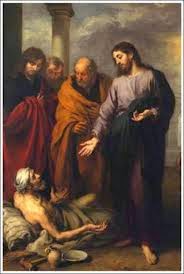
In John 5:1-16 Jesus goes to a feast in Jerusalem on the Sabbath. There is man there who has been lame for thirty-eight years. Jesus heals this man and tells him to take up his pallet and walk. This man obeys. However, the Jews become angry with man because he is carrying his bed on the Sabbath. This story ends just like the one in Mark. The Jews want to kill Jesus because he heals on the Sabbath.
These stories teach us about our Savior and about the nature of faith. These stories also teach us about how blind legalism makes us. Because of their adherence to man made laws and their failure to grasp God’s mercy the Pharisees were blind to the glory they were witnessing.
They were blind to the glory of a man set free.
Here is a man who has been lame for 38 years. He has sat waiting to be healed. No healer came. Day after day, month after month, year after year his bondage continues. Then finally he is healed. And what do the Jews say, “You can’t carry your bed. It is the Sabbath.” In Mark a man is freed and they want to kill the One who cut his chains. Instead of rejoicing in what God has done, they murmur and complain about how their laws are not being followed. They murmur and complain because someone is here who is greater than them.
Christ came to make men free. He came to heal our souls. We are broken. He came to fix us. We are dead. He came to raise us. We are blind. He came to help us see. One day our bodies will be made whole. But legalism says this good news is not good news at all. For a legalist there is no joy in men being set free. There is only skepticism and furrowed brows. “I am so glad that person has come to Christ, but her dress doesn’t reach beneath her knees.” A man returns to church after years of rejecting the faith, but he brings in his third wife. Legalism says, “You better watch that man. He may lead our families astray.” A family is broken and comes to the church for help, but all legalism can see is everything dad and mom did wrong over the past fifteen years. Legalists are always interested in more bondage. They have their eyes peeled for all the “t”s that are not crossed and the “i”s that are not dotted. They cannot rejoice in the salvation Christ has brought. Instead they must find a way to put on new chains. Yes we know you were lame for 38 years and now can walk. But remember carrying your bed is a sin.
They were blind to the glory of God’s law.
In the Gospels, there are many battles over the Sabbath. It is almost like Jesus purposely chose the Sabbath to do miracles just to make the Pharisees mad. Jesus had one view of the Sabbath. The Pharisees had another. For Jesus the Sabbath is about freedom, joy, and healing (Mark 3:4). For the Pharisees the Sabbath is about control, power, and making sure people toe the line. In these two groups we have a summary of how men view God’s law in general. Some see it as a burden to be placed upon men so they will know what lines are not to be crossed. For others, God’s law is the source of freedom. It is not a burden, but a joy. It is not a place where God’s wrath is expressed, but his mercy. The law is used to free men, not bind them. The first view inevitably leads to more and more laws, more and more precision, more and more commandments. The second view inevitably leads to fewer laws (remember Matthew 22:34-40 and Romans 13:8-10), less precision, and less commandments. However, the second view does not lead to more sin. Love of God and love of neighbor, as defined by Scripture, is the ultimate deterrent against sin and the ultimate motive to obedience.
For legalists God’s law is not about freedom, glory, and mercy. The Sabbath isn’t about rest. It is about obeying the commandments. Worship isn’t about joy and delight in God’s presence. It is about the rules. I am not arguing against rules. But rules are not the point. The point is mercy, peace, joy, freedom, love in the Holy Spirit. They miss the spirit and the aim of God’s law. Even when His law convicts the intention is mercy and joy. Even when it cuts like a knife the goal is healing. The legalists does not get this. For them the law is there to make people pay. It is God’s great chain to keep men from straying too far from home.
Legalism misses the point of God’s law. But beyond that legalism adds to God’s law. It makes man-made rules and regulations equivalent to God’s Word. It binds consciences to the commandments of men. Legalists use long, winding roads through Scripture to prove that their laws are really God’s laws. Their opinions become the voice of God. They won’t say this of course. But their actions say, “If you want to be holy, live like me.”
They were blind to the glory of Christ.
Both the previous points pale in comparison to this one. The Pharisees, as least in theory, had been waiting for the Christ, the Anointed One, the Messiah. One day they enter the synagogue or go to a feast and there He is. The Son of David has put on flesh and walked into their worship service. He takes the withered hand and makes it whole. He takes the lame and makes him walk. Prophecy is being fulfilled right before their eyes. Rejoicing is in order. Right? Not for the Pharisees. For them, Christ is a threat to be extinguished instead a Savior to delight in. When Christ was born the scribes of Israel ignored him (Matthew 2:4-7). They can ignore him no longer. Now they want to kill him.
Why? The presence of Christ threatens their world. They have created a system that allows them power and at the same time protects them from accountability. They view themselves as the righteous ones (Luke 18:9-14). They do not see themselves as sinners, like that prostitute. They are sons of Abraham (John 8:39). They are in the covenant. They do not need a Savior. They do not need to be rescued or redeemed. Those people out there, the sick, the lame, the adulterers, the tax collectors those are the ones who need Jesus not them. They have it together. They are the example to be followed.
Christ did not come to support our man made ideas about holiness. He did not come to make the righteous feel good about themselves and the sinners to be cast out or despised. He did not come so our laws could be fulfilled. He came to fulfill God’s Word and save sinners, like me and you. The reason the Pharisees missed the glory of Christ is because they wanted the glory for themselves. A legalist is fixated on himself. He wants the approval of others. He wants to be recognized in the street for his good deeds and holy life. A man like this is blind to many things, but most of all he is blind to the glory of Christ.
Questions
Do you delight when Christ sets men free? Or do you grumble when the lame walk and sinners repent?
Does God’s law bring you freedom, joy, peace, and delight? Would people know from the way you live and talk that God’s law is freeing? Or do you use God’s law to control men? Do you try to make everything you do into a Biblical command? Do you bind consciences to your laws instead of God’s?
Do you glory in Christ? Is his name the one you boast in? Is his glory what you seek? Or are you the center of your world? Are you constantly looking for people to approve of you, to think you are a good Christian? Do you view yourself as a sinner saved by grace or as a pretty good person whom Christ gave a boost to?



 Singing & Slaying