
Do All Infants Who Die Go to Heaven?

gravestones-1This is a repost from last summer with a few slight revisions. 
In light of the millions of babies that have been killed by abortion since 1973 Pastor Sam Storms asks the question, “Do All Infants Who Die Go to Heaven?”  He is tentative with his argument, but still believes that “all who die in infancy…are among the elect of God.”

He gives eight arguments to prove his point, which I summarize below. All Scripture references are his.

1. Romans 1:20 says that all who are exposed to general revelation are without excuse. Since infants are not “recipients of general revelation” then they have an excuse and are therefore “not accountable to God or subject to wrath.”

2. There are passages that assert that infants do not know good from evil (Deut. 1:39).

3. The story of David’s son dying after David’s adultery with Bathsheba. David says he will go to his son, which would indicate that his son with God.

4. There is the consistent testimony of Scripture that we will be judged according to our works (II Cor. 5:10, I Cor. 6:9-10, Rev. 20:11-12).

5. An infant sent to Hell would know pain and suffering, but would not know why he was there. He would be conscious of his suffering, but not conscious of his sin.

6. Some infants are clearly regenerate in the womb (Jeremiah 1:5, Luke 1:15).

7.  Honestly, I am not sure what he is arguing with his 7th point. He talks about Matthew 19:13-15. But what he is trying to prove or disprove from the passage is unclear. If someone can explain his point to me, please do.

8. Here is a direct quote from his 8th point, “Given our understanding of God’s character as presented in Scripture, does he appear as the kind of God who would eternally condemn infants on no other ground than that of Adam’s transgression? Again, this is a subjective (and perhaps sentimental) question. But it deserves an answer nonetheless.”

Storms believes “the first, third, fourth, fifth, and eighth points sufficiently convincing” to prove “the salvation of those dying in infancy.”

Let’s walk through his points one by one. Continue reading
Do Children Interfere with Public Worship?

More from The Nursery of the Holy Spirit. All punctuation is the author’s except the brackets.

While worshiping with our children is difficult and often very exhausting work, it is desirable.  Keep in perspective the eternal blessings that make your perseverance worthwhile. When you remember the purpose of the “the Lord’s Day” (Rev. 1:10), the earthly and temporal difficulties of children in worship are put in there heavenly and eternal perspective. The Lord’s Day is not only a day of earthly, temporal, and physical rest (which may even seem impossible when you have little children), but it is also a day in which our time in worship is time in the presence of the Triune God of grace. Therefore it is a day of heavenly, eternal, and spiritual rest. When you remember the nature of public worship is not merely what we do and what we get out of  it, but instead first and foremost God’s service to us, then all the difficulties are put into their heavenly and eternal perspective. God’s grace is the priority in worship as he serves us by bringing us into communion with our Lord Jesus Christ in the power of the Holy Spirit. He does this by using the external means of the preaching of the Word of God, the celebration of baptism and the Lord’s Supper, and prayer. The Lord’s service to us brings us spiritual rest and refreshment. His service to us, then, creates in us and elicits from us our response as we serve him by praising him in song, prayer, offering, and even by serving each other in fellowship.

Let me put it before you in a very pointed question: do you believe that your children interfere with God’s purpose on his day to serve us…we should welcome little children into our services with us because, like the children above [Mark 10:14-16], we desire our little ones to come into Jesus’ presence to receive his spiritual nourishment even as we need it.

Our Children Belong to the Covenant of Grace

Why should our children be with us in worship? They belong to the covenant of grace.

Our children belonging to the covenant of grace and receiving the blessings of it is like belonging to a family. As members of a family, everyone from the oldest to the youngest receives the blessings of the family such as love, shelter, and guidance. We do not regard our children as outside our family any more than we should regard them as outside God’s family, the church. As one writer stated, why would the Apostle Paul go out of his way to address the children of the congregations of Ephesus [Eph 6:1-4] and Colossae [Col. 3:20] if they were not part of the covenant of grace?

This is from the excellent little book, The Nursery of the Holy Spirit. 

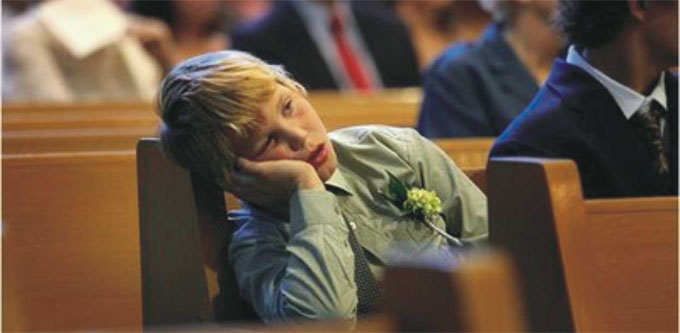
Bored Parents, Bored Children

bored-kid

Pastor Danny Hyde on why some children are bored in public worship

Another practical point you need to consider is that the greatest stumbling block for your children in worship is not that they are bored or because nothing is “at their level,” but that you as their parents do not convey in words and deeds that your cherish holy worship. Keep this saying in mind: worship is better caught than taught. What does this mean?  It means that our children learn by participating in worship more than by our explanations of worship. Therefore your children feel the difference between duty and delight. They will pick up from you a dour attitude if you have a dour attitude. They will come  to believe that worship is not important if you do not show them it is important. As a parent, you are the greatest example to your children of the meaning and value of worshipping the Lord. Having your children with you in worship allows them to be taught about by what they have caught in worship as their eager eyes watch you model this Lord’s Day after Lord’s Day…You must love to worship your God so that your children will learn to love him through the liturgy [order of serve] your church utilizes. After all, you cannot preach what you do not possess or have not first preached to yourself.

I have nine children ranging in ages from 1 to 17. I have a tenth child on the way in December. I have been getting kids ready for church, getting them into various vehicles, walking with them into church, rounding them up before worship, sitting with them in worship, and watching them after worship for over fifteen years. I know how hard Sunday mornings can be, especially when there are little ones. How can a parent maintain joy, wonder, and gratitude when Sunday mornings can be so difficult?

The answer, as usual, is faith. As parents we must believe that the most important and beneficial event in our lives and the lives of our children is Sunday morning worship. No matter how messy, tired, and hard getting there and being there is, God meets us and our children on Sunday mornings in a way he does not during the week.  Our spiritual lives depend upon Sunday mornings as our physical lives depend upon food. We need it. And God is worthy of our time, attention, and effort and that of our children’s. He is the one who made us, saved us through His Son, and makes us holy through His Spirit. While we know this from Monday through Saturday, Sunday morning reminds us Who we worship and why. If we believe and make our lives conform to these two great truths, that God meets us in worship and he is worthy of our worship, then we will find ourselves teaching our children not just by words but more importantly by our example that worship is a delight.

Book Review: The Nursery of the Holy Spirit by Daniel Hyde

The Nursery of the Holy Spirit: Welcoming Children in WorshipThe Nursery of the Holy Spirit: Welcoming Children in Worship by Daniel R. Hyde

My rating: 5 of 5 stars

What a great little book on including our children in public worship! Pastor Hyde does a great job laying out the Biblical and practical reasons for putting our little ones on our laps or beside us on Sunday morning. He does so with cheerfulness and without being too harsh. He does not make this a hill to die on, as some in the family integrated church movement do. But he does clearly indicate its value. Along the way he carefully articulates the place of children in the covenant. Also it has a great bibliography, which us book lovers always like.

The only problem? The book costs too much. It is only 60 pages long and retails at $15.99 with used copies going for $8.00 plus shipping. Someone needs to take this book, fix a few typos, and bring the price down to about $5-8. If they did I would buy some for every family at my church.

I highly recommend this book for all pastors, elders, worship leaders and all those interested in children and their place in the church.

View all my reviews