
The Necessity of Heart Religion

Last week I noted in this post that the definition of morality has shifted frombeing defined by a law to being defined by what harms other people. (See point number six in that post.) Wrong and right used to be linked to a transcendent moral law and for most of Western Civilization that moral law was God’s character as described in His Word. But today morality is often defined by the harm it does to others. That could be one reason why in the latest Barna report more people are concerned about consuming too much water than they are about watching porn. Consuming too much water causes harm while porn really hurts no one. At least that is the line we have been fed.

Here is good illustration of the shift. Is it immoral to take ten dollars from a multi-millionaire? Is any harm going to come to him when I do this? Many would say it is not immoral because it does not hurt him. What about using porn to enhance my sex life with my wife? What harm comes from that? What about coveting something? Or hating someone, but never acting on that hatred? Does pride hurt anyone?  For many people, even Christians, the standard for right and wrong has moved from a transcendent law to whether or not it does harm. That is why any consensual sexual act is considered okay. No one gets hurt so it can’t wrong. This is also why it is okay to steal from the rich, but not from the poor. The rich can “afford” it.  It does not hurt them.

However, what is right and wrong is not defined by the harm it does to others, though it does harm others. Sin is defined by God’s character as expressed through His Word. To answer the question, “Is it wrong to take ten dollars from a millionaire?” we don’t look to the harm done, but to God’s law. The answer we find there is, “Yes it is wrong whether or not it harms anyone (Exodus 20:15). What tangible harm comes from wrong worship?  Yet God says he hates it (Amos 5:21-24). Does lusting after a woman hurt anyone? Yet Jesus clearly condemns it (Matthew 5:28). Many sins in Scripture are internal. They will eventually show themselves and they do harm to the one sinning and those around him. But often these internal sins can remain buried for years and in some cases decades. Are these internal sins, such as lust, coveting, anger, bitterness, etc. still a problem if no one sees them and the harm is minor or unnoticeable? The Bible’s answer is yes.

Sin is about me and God. That is the key.  It is not just about me and God. My sin impacts all those around me in various ways. But it is primarily about me and God. That is why David says, “Against you and you only have I sinned” (Psalm 51:4). He had just killed a man after sleeping with his wife. But it was still God to whom he must give an account (Hebrews 4:13). And God does not just see what you do, He sees who you are. Too often pragmatism rules in our pursuit of holiness. I am holy when I am nice, keep fellowship with other people, etc. But holiness is defined by the unchanging character of the living God not by the immediate impact of our actions and attitudes upon other people.  That means what goes on inside us is just as important as what we do. Our heart matters. What we believe matters. Our lusts that no one sees. Our pride that we keep hidden. Our bitterness that is locked away matters to God.  What does this mean for us?

First, why we do something is important.  We can do the right thing for the wrong reason, which makes it a sin. I can be nice to someone so they will pay me back. I can go to worship so other people will believe I am a good Christian. I can tithe so the church will have to do what I say. I can preach for the praise of men. I can read my Bible so I have a tool to use against others. The why matters as much as the what. Our desires and motivations, which no one can see, matter to the Lord.

Second, we can do the right thing and other people get hurt. Holiness is not defined by the harm caused others. Therefore sometimes holiness, that is obeying God’s commands, can cause us to do something that harms others. Obviously, harm here is a relative term. But if I rebuke someone they will feel hurt, even if it was the right thing to do. If I turn a man into the police for child abuse he will feel hurt, even if it was the right thing to do. If a woman is excommunicated for her adultery she will feel hurt.  A person’s reaction does not determine whether or not an action is right or wrong.

Third, the key deterrent to sin is the fear of the Lord, not the fear of consequences. That does not mean fear of consequences is unimportant. But that is for children in the faith. As we grow the primary motive to holiness is the love of and fear of God. If consequences keep us from sinning then when we cannot see the consequences or when those consequences are small we will sin. That is why so many Christian men can indulge in pornography with little shame and guilt. Or when they get caught all they are concerned about is the consequences, such as losing their wife.

Finally, this means we must cultivate heart religion. We must be students of our hearts. We must guard our hearts, keep our hearts, and examine our hearts. We must hold not just our actions, but our attitudes up to the mirror of God’s Word. Holiness begins on the inside. The Bible repeats this theme from beginning to end. Here are a few examples:

Genesis 8;21 And when the LORD smelled the pleasing aroma, the LORD said in his heart, “I will never again curse the ground because of man, for the intention of man’s heart is evil from his youth. Neither will I ever again strike down every living creature as I have done.

Deuteronomy 6:4-6″Hear, O Israel: The LORD our God, the LORD is one. You shall love the LORD your God with all your heart and with all your soul and with all your might. And these words that I command you today shall be on your heart. 

Psalm 51:6, 10 Behold, you delight in truth in the inward being, and you teach me wisdom in the secret heart.Create in me a clean heart, O God, and renew a right spirit within me.

Isaiah 51;7 “Listen to me, you who know righteousness, the people in whose heart is my law; fear not the reproach of man, nor be dismayed at their revilings.

Matthew 15:16-20 And he said, “Are you also still without understanding? Do you not see that whatever goes into the mouth passes into the stomach and is expelled? But what comes out of the mouth proceeds from the heart, and this defiles a person. For out of the heart come evil thoughts, murder, adultery, sexual immorality, theft, false witness, slander. These are what defile a person. But to eat with unwashed hands does not defile anyone.” 

Hebrews 3:12 Take care, brothers, lest there be in any of you an evil, unbelieving heart, leading you to fall away from the living God. 

I Peter 3:4 but let your adorning be the hidden person of the heart with the imperishable beauty of a gentle and quiet spirit, which in God’s sight is very precious. 

These passages, along with many others, teach us that sin resides in the heart. There are outward actions that follow from our heart attitudes. But the heart is the key.  Heart religion, an inward fear of and love of God that leads to right action is the goal of the Christian life. We cannot say that holiness is primarily defined by the harm it causes others. If we do that we will inevitably ignore the holiness of the inner man that Scripture demands.

But how can we do this? Can we truly know our heart? Do any of us operate from pure motives? How does the death, burial, and resurrection of Christ and the sending of the Spirit help us in this matter of heart religion? What does justification by faith alone have to do with this? How do we keep from becoming paralyzed from constant examination of our hearts? How do I keep this from becoming self-centered in my pursuit of heart religion? I will look at these questions in a later post. For now, let us understand that God sees the heart, not just the hands. Therefore doing the right thing is not enough. Our hearts must be right as well.

Similar Posts:
Tear Your Hearts
Dangers of Being a Man- Pleaser
The Pharisee and the Tax Collector
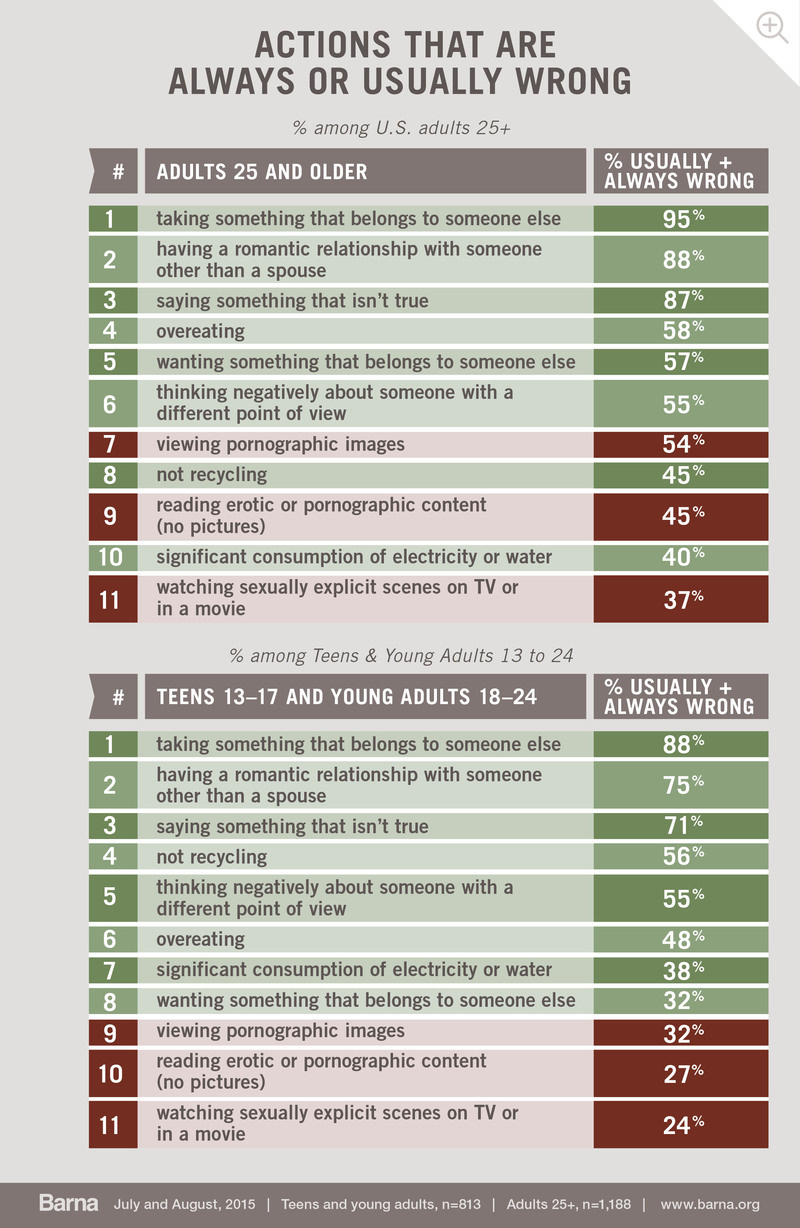
Recycling vs. Porn: Thoughts on the Latest Barna Report

Below you can see a poll taken by the Barna Institute n the summer of 2015. Note this is not a poll of Christians, but of the general population. Polls are not airtight. What the specific question was, how many people were asked, what their background was, etc. can all play a roll in the final statistics. But polls like this can give us a general feel for the trajectory of a society. Sometimes when we hear a presidential candidate is ahead in the polls by 10 percentage points we know that poll does not sync with reality we see around us. Something is off. However, with this Barna poll, we are not surprised by what we read. What the poll says is lines up with what we see in the world around us. When the poll says that 76% of people under the age 24 do not think it is wrong to watch sexually explicit scenes on TV or in a movie is anyone surprised? You can read the whole report along with some analysis here. Here are few randoms thoughts I had from the report.

First, it is clear that the younger generation is not bothered nearly as much by sexually explicit material whether pornographic or otherwise. I am not sure there is much difference between a sexually explicit scene in a movie and porn. Many shows on HBO and Netflix contain graphic sexual content. I am 38 and this comes as no shock at all. I am surprised the numbers are as high as they are. But remember porn is the fruit, not the tree. The tree is loss of the authority of God’s Word to dictate both actions and attitude. 
Second, but even in the older generation 46% of people do not think it is wrong to view porn and 63% do not think watching sexually explicit TV shows is wrong. Those are still awful numbers. We are so dead to this sin that we consider it a victory when roughly one out of two people think porn is bad. 
Third, my guess is the question  about “reading erotic or pornographic content” is directly connected to Fifty Shades of Grey. There were erotic stories around before that book. But that book popularized the erotic story, though sex scenes in romantic novels are common place.  
Fourth, the discrepancy between recycling and porn among the younger generation is striking. 56% of young people think it is always wrong or usually wrong to not recycle. While on 32% would say the same about view pornographic images. Not recycling is a moral failure much greater than porn. Young people think it is a greater moral duty to put aluminum cans in the recycle bin than it is to avoid watching other people have sex.  
Fifth, the third item in each list is lying. But among the younger generation the percentage who think it is wrong has dropped by 16 points. Lying is still considered a moral failure, but by fewer and fewer people. Almost 3 out of every 10 folks under 24 think it is fine to lie. This disturbs me almost as much as the porn statistic. 
Sixth, I am not sure about this, but my guess is that the reason certain actions are higher is because they directly affect other people.  Why would porn be so low, but adultery be so high? Both are sexual sins. According to Jesus porn is adultery on some level (Matthew 5:28). But porn is considered innocent because no one is harmed while in adultery someone is harmed. I would also guess that is why theft still remains so high. We are taking something from someone else. Here we see the shift from sin as an affront to God’s character and a breaking of His law to sin as that which harms someone else. Once this switch is made the only question becomes, “Does anyone get hurt?” If the answer is no then it cannot be wrong. Why is recycling so high and watching Game of Thrones so low? Not recycling hurts our planet and ultimately our children. Watching sex and nudity on TV does not harm anyone or so the culture says. Until the church once again preaches the fear of God and man’s need for obedience from the heart she will find her members defining sin less and less in line with God’s character as given in His Word and more and more in line with what the culture considers “harmful.” 
Seventh, while adultery is still high it does drop over 13 points between generations. 
Finally, notice the drop in covetousness or as the poll so delicately put it “wanting something that belongs to someone else.” There was a drop of 25 points from the older generation to the younger one. 68% of those 24 and under think it is fine to covet. More people think it is wrong to consume too much electricity than it is to covet. This is not surprising at all given my sixth point. Sin has become something which harms others. How can lusting after my neighbor’s car or my neighbor’s wife be a problem when no one gets hurt? What I find interesting is for Paul coveting was the key to showing him his own need for Christ (Romans 7:7). 
There is one way this data could be interpreted more positively. Young people are often ignorant and foolish to the results of certain actions. As they grow up their beliefs change and generally become more conservative. It is possible that many of the 20 year olds who think porn is just fine now and recycling is so terrible will not think the same thing when they are 40. However, this requires that they be taught, learn, and grow. It also usually requires marriage, children, and a job. And while this has often been the pattern in the past, I am not holding my breath that it will repeat itself in the coming decades. My fear is that our educational system, impotent pastors and fathers, a failure to preach God’s Word in all its fullness and to exhort people to obey it, a government that keeps men dependent, a hatred of women, children, and marriage, and a coddling of minds and bodies will not lead to the 15 to 20 year olds growing up. At the current rate and in the current cultural situation, it is hard to view these statistics getting better. 

Psalm 119:17-19~Help for Pilgrims


Psalm 119:17-19 reminds us that the grace of God is essential for obedience to his Word and understanding of his Word. The Psalmist understands that he is weak and blind. He knows that God’s Word requires much of him. He knows that God’s Word is often shrouded in darkness. The meaning and the application of it can be hard to discern. He knows the human heart is like a rock unable to receive the seed of the Word. He knows that we are fallen, weak men who need God’s strength to help us obey.  Therefore he begins this third section of Psalm 119 with a plea for help.

He asks God to deal bountifully with him. This word is used in several other Psalms to express God’s great kindness (Psalm 13:6, 116:7, 142:7). The psalmist is asking the Lord to open up the treasures of his grace and pour out his goodness upon him. The psalmist is a servant of the Lord. But what does he ask God to do for him? He wants God to be kind to him by helping him walk according to God’s Word. What a great prayer!  Oh, Lord show me your grace so that I might obey your commandments. The Psalmist understands that grace, God’s unmerited kindness, precedes obedience. If he is going to live and keep the Word, grace must come first. 


Next the psalmist cries out to God for understanding of his Word. The phrase translated “wondrous things” means something that is surpassing in its greatness, but at times hard to understand. God’s Word is wonderful and filled with treasure beyond all the wealth of this world. But it can be difficult to grasp. There are passages that we must think about a long time before we come to understand them. Sometimes we understand what a passage means, but are not sure how it impacts our lives.  The psalmist knows that he is blind. He needs God to remove the scales so that he can understand and obey. Verse 18 is a great little prayer to recite prior to reading God’s Word or hearing the Word preached.

Finally the psalmist asks God to unveil his Word because he is as stranger in this world.  He, like all Christians, is passing through looking for that final house whose builder is God.  It is the nature of man to find himself too at home in the world. He forgets eternity and his own immortality. He becomes too entangled in the affairs of this earth and the end becomes blurry. An older author described this as putting anchors down in the world. We become tied to this world by a thousand ropes. While Christians can and should enjoy the many gifts God gives in this life, our eyes should not lose sight of the final destination. Calvin says we are to “aspire after the place we are invited.” We are to long for our heavenly home. But why does this lead the psalmist to pray that God would not hide his commandments from him? What is the connection between being a stranger in this world and seeing God’s commands rightly?

Any stranger in a foreign land needs maps and brochures to keep him from straying and to bring him safely back home. God’s Word furnishes us with a map for navigating this world. We are strangers, but the Word can give us direction. It tells what to believe and not to believe. It provides us with a picture of sin and death. It reminds us of God’s purposes for this world and how it can be used to his glory. But it also reminds us that our final home is not here, but there.  The Word provides comfort when we grieve in this fallen world by pointing us to the next world.  Finally, the Word draws our eyes forward to the new Heavens and Earth when we will swim in the glory of God, when all things will be made new, when all pain, death, and sorrow will be eliminated, when our old bodies will put on incorruption, and when we shall Christ as He is.  He prays Psalm 119:19 because God’s Word provides direction, comfort, and vision for wandering pilgrims, like us. 

The key point of these three verses is that we need the grace of God to obey his Word, to understand his Word, and to use his word to guide us in this world. 

Other Posts on Psalm 119
Psalm 119:2-4
Psalm 119:7
Psalm 119:9
Psalm 119:11
Psalm 119:13
Psalm 119:14
Psalm 119:15-16

Psalm 119:15-16~Study, Remember, Obey

Psalm 119:9-16 ends with four ways the psalmist will “take heed to God’s Word” (vs. 9). He will meditate on it, contemplate it (fix my eyes-ESV), delight in it, and will not forget it (Psalm 119:15-16).  These last two verses show that the psalmist takes seriously his own need to focus on and retain God’s Word. 
Those things which we find most delightful are those things that we roll over and over in our minds. When a young man is courting a lady she is never far from his thoughts, even if he is not speaking of her.  So it should be with God’s Word. When there is delight in God’s Word (Psalm 119:14) we meditate upon that Word. When we recognize our need to “keep our way pure” (Psalm 119:11) we ponder and contemplate the Word of God day and night. Though a different word is used, this verse expresses the same idea as Psalm 1:2. Meditation and contemplation means there is serious study of God’s Word and a daily attempt to obey God’s Word. The Psalmist says he will contemplate God’s ways, which means how the Lord would have him live. Psalm 119:15 weaves together the intellectual focus on God’s Word and the practical walking in God’s Word.


But meditation and contemplation are not all. The psalmist goes on to repeat that he delights in God’s Word. This has been said once already (vs. 14). But it is repeated for effect. Delighting in God’s Word is one of the proofs that we have meditated on it properly. If study does not lead to delight we have missed something. Even when our sin is exposed in the reading of God’s Word we should rejoice. God is showing us our faults and seeking to form us into the character of his Son.

Finally the psalmist says that he will not forget God’s Word. Like delight the psalmist repeats a previous idea. In verse 11 he says he hides God’s Word. Here he says something similar. God’s Word should not be a seed thrown on stony ground that is snatched away by birds. It should take deep root in our hearts, minds, and lives. How many of us are content with a shallow understanding of God’s Word? How many of us are content with reading of God’s Word but not the planting of God’s Word? The psalmist isn’t. He wanted the law of God woven into his thoughts, emotions, and actions.


Here are several points to remember from Psalm 119:15-16.

We need time to meditate on the Word of God. Reading is good, but not good enough.  We need to taste the word over and over. We need to take passages and go deeper with them, asking more and more questions of them, thinking through how the Word applies to us. Our hearts, though renewed, are often reluctant to take time with God’s Word. We are busy people. But if God’s Word is to fill our minds and direct our ways then we must resolve to do more than just read. We cannot meditate every time we read God’s Word. But there should be times where we slow down and spend time savoring God’s Word. This is a great activity for Sunday afternoons. Take a passage, several chapters, or even a short book of the Bible and spend some time with it. Take some notes on it. Pray through it. Read it out loud instead of silently. 

Delighting in God’s Word is a sign of maturity in one’s walk with God. All Christians should read the Word. But mature Christians delight in it. If God’s Word is dry, dull, or dead to us then something is wrong. Leaders, such as fathers and pastors, especially must have a deep delight in the words of God. They must set an example for their homes and churches of men who love God’s Word and find it sweeter than honey and more profitable than the riches of this world.  This does not mean that every time we read God’s Word we will feel lightening from Heaven, just like every time I kiss my wife it will not be like lightening from Heaven. But our joy and delight in God’s Word should go deeper and deeper.

Finally Psalm 119:9-16 is focused on hiding or not forgetting God’s Word. The Psalmist ends by saying, “I will not forget your word.” Many of us are like buckets with holes in the bottom. God’s Word goes in and then goes out. We must learn to keep God’s Word in minds and in our hearts. We do this by systematic memorization of it, regular meditation on it, singing it, and diligent obedience to it.

To sum up Psalm 119:9-16 we could say, When we delight in God’s Word and know that it is necessary for holiness we will take the time and energy necessary to study it, remember it, and seek new ways to obey it. 

Other Posts on Psalm 119
Psalm 119:2-4
Psalm 119:7
Psalm 119:9
Psalm 119:11
Psalm 119:13
Psalm 119:14

The Way to Preach the Gospel

John Calvin’s sermons are quite different in tone from his other writings.  Few things have changed my opinion of Calvin as much as reading what he said to the congregation he preached to week in and week out. Here is are two great quotes from his sermon on Acts 3:17-19:

In fact, if we only proclaim how God shows himself to be our Father through our Lord Jesus Christ, a few will accept that, but to no avail unless we first lead them to a knowledge of their sins so they will be grieved by them. In this way, we also must be cast down in ourselves if we want our Lord to lift us up. Then we will know it is not in vain that we confess that our lives are filled with nothing less than filth and contagion. Not only must we make that kind of general confession, but each of us must also confess his particular sins before God if we are to be humbled under his strong hand. May our arrogance, our rebellion, and our wicked affections not keep us from recognizing the truth expressed here, that there is no salvation except through Jesus Christ, and for that that reason we must cling unreservedly to him. 

Calvin is expressing the need for men to recognize their sins in all their ugliness before they will come to God. Notice his emphasis not just on general confession, but also on confessing “particular sins.” Many men will confess they are sinners without confessing their sins. Throughout this sermon Calvin shows great balance. Men need to see their sins clearly. But they also need to see God’s mercy in Christ clearly. To remove the first is to give a man no need to run to Christ. To remove the second is to give them nowhere to run. Here is a second quote from later in the sermon. Calvin does something he is known for. He gives his people an example of what words could be said,  which also sum up his points.

So let us always acknowledge our sins so that we may be grieved by them, and then let us look to God’s mercy so that we may come to him in all humility and say, “Alas, Lord here we are on the road to hell. We are guilty and worthy of everlasting death because of the sins we have committed against your holy majesty, but you do not desire the death of sinners before they are converted and enter into life. With confidence in your great mercy we lay claim to it, asking you not to look on the enormity of our sins, but to look upon with pity, pardoning us by your freely bestowed kindness.” This is the way to preach the gospel. After people are overwhelmed by the knowledge of their sins, they must be brought to repentance and shown this is not a matter of putting on a happy face for God with the thought of deceiving him by pretense and hypocrisy, as people are accustomed to doing. That is not the way they are to come to him, but when they want to be truly repentant, they must be displeased with themselves and displeased for having offended Go. When they are thus affected, offer them God’s mercy so their sins will be forgiven, provided they return to God, as we said earlier. 

It is hard to find a clearer or more affecting statement of the gospel than what is in the quotes. Calvin clearly articulates our total depravity, lack of merit, condemnation, and sinfulness alongside God’s great holiness and mercy. Notice that Calvin uses “us” and “we” a lot. He included himself among those who needed this great gospel. The gospel was not for the congregation. It was for all men, including the pastor.  As I have read Calvin’s sermons I have tried to use “us” and “we” more.