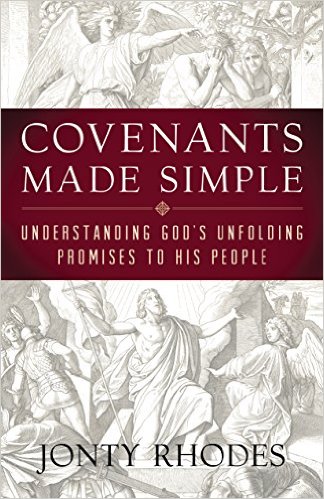
S&S Podcast 2016.23~Book Review: Covenants Made Simple

Covenants Made Simple

A review of Jonty Rhodes’ helpful book Covenants Made Simple.


Book Review: War, Peace, and Christianity by Charles and Demy

War, Peace, and Christianity: Questions and Answers from a Just-War PerspectiveWar, Peace, and Christianity: Questions and Answers from a Just-War Perspective by J. Daryl Charles

My rating: 5 of 5 stars

In my circles people talk about just war all the time. But rarely was it defined or described. What is a just war? I bought this book hoping for two things: 1. It would give me the basic parameters of just war theory. 2. It would give a me a lot of footnotes that would point me to other sources. I got both of these in spades.

The authors use a question and answer format to describe what just war is, what it is not, some questions that still need answered, and the history of just war. They talk about just war in relation to philosophy/natural law, history, the statesman, the theologian, the combatant, and the individual.They rely heavily on Aquinas, Grotius, Vitoria, and Suarez. The also use a lot of O’Donovan and a current just war writer named James Turner Johnson. They address terrorism, nuclear war, humanitarian intervention, the UN, post war development of countries, non-lethal weapons, “turn the other cheek,” does war violate the command to not kill, did Jesus change our approach to war, is just war only a Christian idea or it can it be found in non-Christian sources, Bonhoeffer’s attempt on Hitler’s life, Ghandi’s pacifism, C.S. Lewis’ writings on war, supreme emergency, the early church on war, including Roland Bainton’s pacifistic reading of the church fathers, criteria for going to war, criteria within a war, private military contractors, ethical development of weapons, Romans 13, etc. etc. The great value of this book is how much ground it covers. You will not get an in depth chapter length discussion of terrorism and just war, but you will get some basic ideas on it. It is an excellent introduction to just war thought, though I doubt any reader will agree with all.

The only drawback I would note is there is a quite a bit of repetition. The reason would seem to be the nature of the book where the questions and answers in various sections overlap with questions and answers in other sections. There are other areas that I would have like more discussion on, such as what makes an authority legitimate, but the sources cited should give provide those if the reader wished to pursue them.

View all my reviews

Dalrymple Takes Down Woolf

Our CultureTheodore Dalrymple is the pen name of a retired British doctor who worked in a prison and a low-income hospital, as well as in Africa. He is a also a writer, a very good writer. I am currently reading his book Our Culture, What’s Left of It. It is a series of essay on various topics. All budding short essay writers would do themselves a great service by reading the opening and closing paragraphs of each essay. He does a great job of introducing and concluding his writings.

Anyway, I am currently reading the essay title “The Rage of Virginia Woolf”, which  could be titled “The Rage of Every Die-Hard Feminist.” Virginia Woolf is a feminist heroine, whose novels are standard works in literature departments as well as women’s studies departments around the Western world. Dalrymple does not think Mrs. Woolf did much to help advance civilization, despite the love she gets from the intellectual elites in the West. Here are some of my favorite quotes from the essay.

[Mrs. Woolf’s book Three Guineas] is a locus classicus of self-pity and victimhood as a genre itself…The book might be better titled: How to Be Privileged and Yet Feel Extremely Aggrieved.

As a female member of the British upper middle class and one of what she called “the daughters of educated men,” she felt both socially superior to the rest of the world and peculiarly, indeed uniquely, put upon.

No interpretation of events, trends, or feelings is too silly or contradictory for Mrs. Woolf if it helps to fan her resentment…As ever wanting it both ways, she complains at one moment of exclusion and at the next, that inclusion is not worthwhile. She is like a humorless version of Groucho Marx, who did not want to be the member of any club that would accept him. What is a joke for Groucho Marx is serious political philosophy for Virginia Woolf.

Resentment playing so large a part in Mrs. Woolf’s mental economy, much of her intellectual effort went into justifying it. She is thus a very modern figure indeed, even though she died sixty years ago. Her lack of recognition that anything had ever been achieved or created before her advent that was worthy of protection or preservation is all but absolute along with her egotism.

For Mrs. Woolf, loyalty to herself was the only real, true loyalty.

It comes as no surprise that a thinker (or perhaps I should say a feeler) such as Mrs. Woolf, with her emotional and intellectual dishonesty, should collapse all relevant moral distinctions, a technique vital to all schools of resentment.

If the good life is a matter of judgment, the war [WWII] proved that all her adult life she had none. My mother, with her wrench by day and helmet by night [T.D.’s mother was a firewatcher at night and mechanic during the day during WWII] did more for civilization…than Mrs. Woolf had ever done, with her jeweled prose disguising her narcissistic rage.

Had Mrs. Woolf survived to our time, however, she would at least have had the satisfaction of observing her cast of mind-shallow, dishonest, resentful, envious, snobbish, self-absorbed, trivial, philistine, and ultimately brutal-had triumphed among the elites of the Western world.


Book Review: Men, Women, and Order in the Church by John Calvin

Men, Women, and Order in the ChurchMen, Women, and Order in the Church by John Calvin

My rating: 4 of 5 stars

I have found myself reading more and more of Calvin’s sermons. While the basic content is the same as his commentaries, the delivery is quite different. Since I am pastor, I enjoy how he preaches a text to the congregation.

This is book is three sermons Calvin delivered on I Corinthians 11:2-16. While there is some discussion of head coverings, that is minimal, more than likely because it was assumed to be right. But what these sermons are good for is a defense of order in the church and hierarchy in general. It is interesting how often Calvin jumps from the relationship of men and women to masters and slaves, rulers and subjects, and other types of hierarchical situations. He applies what he sees in I Corinthians 11 to other aspects of social order because he believe that God made the world hierarchical. Therefore, “This natural order did come about by chance; rather God reveals his will by it, and means to test our obedience to see if we will submit to him.” He sees order, that is social hierarchy, as essential to the church and society.

Calvin believes that women are made in the image of God just like men. “As for the image, it is certain that is pertains to all females as well as to all males.” Yet Calvin also believe that women were subservient to men “as a class.” He did not see this as denigrating women, but rather as following God’s appointed order and structure.

These three sermons are much more a defense of order and hierarchy than a defense of head coverings. And for that reason they should be read.

My Rating System
1 Star-Terrible book and dangerous. Burn it in the streets.

2 Stars-Really bad book, would not recommend, probably has some dangerous ideas in it or could just be so poorly written/researched that it is not worth reading. Few books I read are 1 or 2 stars because I am careful about what I read.

3 Stars-Either I disagree with it at too many points to recommend it or it is just not a good book on the subject or for the genre. Would not read it again, reference it, or recommend it. But it is not necessarily dangerous except as a time waster.

4 Stars-Solid book on the subject or for the genre. This does not mean I agree with everything in it. I would recommend this book to others and would probably read it again or reference it. Most books fall in this category because I try not to read books I don’t think will be good. There is a quite a variety here. 3.6 is pretty far from 4.5.

5 Stars-Excellent book. Classic in the genre or top of the line for the subject. I might also put a book in here that impacted me personally at the time I read it. I would highly recommend this book, even if I do not agree with all that it says. Few books fall in this category. Over time I have put less in this category.

View all my reviews

Book Review: A Holy Vision for Family Life by William Gouge

A Holy Vision for Family Life (Building a Godly Home #1)A Holy Vision for Family Life by William Gouge

My rating: 4 of 5 stars

This is the first of three volumes on a Christian home. In our modern context this first volume would not be written. We are a very practical age. Give tips on how to my marriage healthy. Give me five ways to raise godly children. But Gouge does not begin there. Instead, a bulk of this book is about Christ and the church. Instead of beginning with how husbands are to love their wives, he begins with how Christ loves the church. Instead of beginning with wives submitting to their husbands, he begins with the church’s subjection to Christ. You will also find a discussion of baptism, what it means for us to be united to Christ, the benefits of our union with Christ, and a discussion of why marriage is not a sacrament.

There are some more practical chapters, but on the whole Gouge lays the theological foundation for his next two books. Therefore it is worth reading, not just for content, but also for his method.

I did have one disagreement. It appears Gouge believes that a marriage can be formed even though it is never consummated. In other words, sex is not a necessary part of marriage. I disagree with this and I am pretty sure most Reformers would as well.

My Rating System
1 Star-Terrible book and dangerous. Burn it in the streets.

2 Stars-Really bad book, would not recommend, probably has some dangerous ideas in it or could just be so poorly written/researched that it is not worth reading. Few books I read are 1 or 2 stars because I am careful about what I read.

3 Stars-Either I disagree with it at too many points to recommend it or it is just not a good book on the subject or for the genre. Would not read it again, reference it, or recommend it. But it is not necessarily dangerous except as a time waster.

4 Stars-Solid book on the subject or for the genre. This does not mean I agree with everything in it. I would recommend this book to others and would probably read it again or reference it. Most books fall in this category because I try not to read books I don’t think will be good. There is a quite a variety here. 3.6 is pretty far from 4.5.

5 Stars-Excellent book. Classic in the genre or top of the line for the subject. I might also put a book in here that impacted me personally at the time I read it. I would highly recommend this book, even if I do not agree with all that it says. Few books fall in this category. Over time I have put less in this category.

View all my reviews