
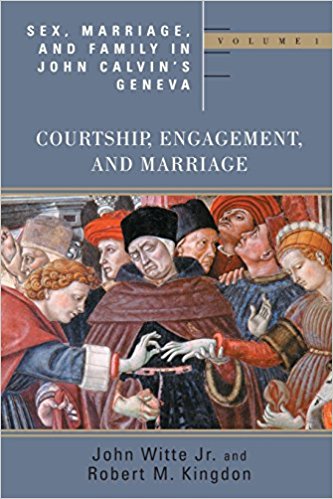
Courtship, Engagement, and Marriage in Calvin’s Geneva

Kingdon and WitteI am going to repost, with some revisions, my blog series on Kingdon and Witte’s excellent work: Sex, Marriage, and Family in John Calvin’s Geneva: Vol 1.  There were supposed to be two more volumes, but Robert Kingdon died. I am not sure the status of the next two books. We cannot nor should we adopt all the specifics of pastoral care in Geneva. However, in our age where moral formation through pastoral care is an afterthought, books like these are of great value. The sheep wander off cliffs regularly while pastors waste their time or better yet push them. This books gives a way godly shepherds cared for their sheep in the a specific time and place. And while we cannot adopt all the particulars, the principles do not change.  And the subject of marriage, children, and sex is never boring and always relevant. 

What pops in your mind when you think of John Calvin? Austere reformer? Man who had Servetus killed? A man who taught that evil, black doctrine of predestination? Or do you think of a man who protected women and children and sought to reform marriage? This latter picture is the one painted by this book. I think most people will find me weird for loving this book so much. But I did. As a pastor I am always looking for different perspectives on pastoral care. This book is a great picture of pastoral theology and care in action during a specific time period. This book is supposed to be the first of three volumes on Sex, Marriage, and Family in John Calvin’s Geneva. I sincerely hope they get the other two written. This one focused on pastoral counsel up to and including the wedding. The next volume will focus on marriage and children. The final volume will focus on divorce, desertion, abuse, and widows/widowers.

Continue reading

Tyrants and Kicking Posts

adam-and-eve


Correct doctrine does not inoculate against sin. Just because the right things are taught sin does not magically disappear. It is easy to believe that if we just teach a biblically grounded view of courtship then all we have to do is set those two young ones lose, following our courtship rules, and all will be well. Or if we have the right liturgy then the parishioners automatically become more righteous. Or if we teach our daughters modesty then all will be well and so on. The trouble with this perspective is that the problem with sin is rarely knowledge. Sin lives within us. Whatever system we have (and some are better than others) we bring our sin into it. Many pastors and parents function as if teaching the right doctrine automatically sanctifies. But it doesn’t. And this why a pastor must preach to his people, not just the right doctrine, but also that right doctrine must translate to right living.

In our church we teach headship and submission. It is a biblical concept. It is one of the key issues of our day, along with numerous other male/female, husband/wife issues. But teaching headship and submission is not a vaccine against headship submission sins. In fact, someone can believe in headship and submission and have a terrible, unbiblical marriage. Here are two specific sins that crop up when a church teaches headship.

Tyrants
There will be men who are drawn to this teaching because they are tyrants. They use headship as a shield for accountability. They love headship because they think it means they get to do whatever they want. My wife is my servant and I am the master. These men are often over-controlling, easily offended, lack real accountability, think their children are too good for anyone else, etc. They keep their wife really close because who knows what will happen if she drifts. They speak in terms of protection, but what they really want is control. They speak of their sins in generic terms instead of specifics. They are good at cultural critique, but not good at self-critique. Continue reading

The Undefiled Marriage Bed

unmade-bed

Recently, I preached on Hebrews 13:4:

Let marriage be held in honor among all, and let the marriage bed be undefiled, for God will judge the sexually immoral and adulterous.

How do we keep the marriage bed undefiled? What should a Christian sexual relationship look like? When we ask this question we tend to begin with the sins. Is this a sin? Is that a sin? But that complicates things. The truth is simple to understand, but hard to live out due to our wayward hearts. The only proper sexual expression is between one and one woman within marriage. Every other form of sexual expression is a sin. Fornication, adultery, bestiality, rape, masturbation, sodomy, lesbianism, multiple wives, and pornography are all sins by the standard that is set in Genesis 1-2. One man and one woman in a marriage covenant until one is dead is the boundary for Christian sexual activity.

This does not mean that all of these sins are equal in their sinfulness. Is fornication as bad as adultery? No. Is adultery as bad as sodomy? No. Does this mean divorce is always wrong? No. Does this mean it is impossible to sin against your spouse sexually and yet remain sexually faithful? No. A spouse can never sleep around or look at porn and still be sinning in the marriage bed.  And yet despite all the “but what abouts” the Lord has given us a paradigm in Genesis 1-2. We love to find loopholes. What is allowed? What can I get away with? Is it really that a big a deal if I masturbate, watch a little porn, or flirt with the married man at work? However, our goal should not be to see how much we can get away with. Instead we should be striving for and teaching the standard the Lord set up: one man and one woman married to one another and faithful to one another in heart, mind, and body until death separates them. The question should not be how close is this to the line, but rather how close does my life conform to the Biblical standard.

Modern Marriage: I Love Me & Commit to Myself

i-love-myself

As America continues her descent into madness, satire becomes a more and more difficult task. Take this article, which explains why women (yes they are all women) are marrying themselves.

Self-marriage is a small but growing movement, with consultants and self-wedding planners popping up across the world.

People are marrying themselves. People are having wedding ceremonies where they make vows to love themselves, be compassionate to themselves, and never leave themselves. Here is one example: Continue reading

William Gouge on a Wife’s Submission

William Gouge (1575-1653) was a pastor in London from 1608-1653.  He was known as a great minister of the gospel, preaching three times a week, and an accomplished author. He also was a prominent member of the Westminster Assembly and help to write the Westminster Confession of Faith. Reformation Heritage Books took his book “Domestic Duties” and broke it down into three volumes. The quote below is from the first book, Building a Godly Home.   All italics are original.

The duty required is that a wife must yield a chaste, faithful, matrimonial subjection to her husband. 

A wife must submit herself to her husband, because he is her head. And she must do it “as unto the Lord” because her husband is to her as Christ is to the church.

The metaphor of a head declares both the dignity of a husband and the duty of a husband. As a head is set above the body, so is the husband to his wife.  As a head, by the understanding which is in it, governs, protects, preserves, and provides for the body, so does the husband his wife. At least, he ought to do so, for this is his office and duty. This is noted here to show the benefit which a wife receives by her husband, so that two motives are included under this metaphor.

The first is taken from the husband’s prerogative, from which note that subjection must be yielded to those who are over us. For this is a main end of the difference between party and party. To what end is the head set above the body, if the body be not subject to it?

The second is taken from the benefit which a wife reaps by her husband’s superiority, and it shows that they who will not submit themselves to their superiors injure themselves, like a body would injure itself, if it would not be subject to the head.

Later on he says this:

To direct and provoke wives to their duty, the apostle adds this clause, “as unto the Lord,” which is both a rule and a reason of wives’ subjection. It directs wives by noting the limitation of their obedience and the manner of it. The limitation is that wives ought to so obey their husbands as they obey the Lord, but no further: they may not be subject in anything to their husbands that cannot stand with their subjection to the Lord. The manner is that wives ought to yield such a kind of subjection to their husbands, as may be approved by the Lord….It provokes wives to submit themselves to their husbands by noting that the place of the husband is to be the Lord’s representative, bearing His image, and in that respect having a fellowship and partnership with the Lord. Therefore, wives in right subjection to their husbands are subject to the Lord. On the contrary side, wives, in refusing to be subject to their husbands refuse to be subject to the Lord.