 Here I continue to look at the changes in marriage during the Reformation. In this post I examine Calvin’s attack on the Roman Catholic view of marriage as a sacrament. The quotes are from Kingdon and Witte.
This post looked at the basic foundations for marriage law in the church at the time of the Reformation. Some of the ideas taught were retained by the reformers, some were modified, and some were rejected all together. The first chapter focuses on the general changes that the Reformation in Geneva brought about to the law. The core change the reformers made was to reject marriage as a sacrament. Here is a short summary of Calvin’s views on marriage.
For Calvin
Marriage is a “good and holy ordinance of God just like farming, building, cobbling, and barbering.” Marriage serves to procreate children, to remedy continence, and to promote “love between husband and wife.” Its morals and mores are subject to the laws of God that are written on the conscience, rewritten in the pages of Scripture, and distilled in the Ten Commandments. Marriage, however, is not a sacrament of the heavenly kingdom. Though it symbolizes the bond between Christ and his Church, Yahweh and his chosen people, marriage confirms no divine promise and confers no sanctifying grace, as do true sacraments. Though it is a righteous mode of Christian living in the earthly kingdom, it has no bearing on one’s salvation or eternal standing.
For the church to subordinate marriage to celibacy is to commit spiritual “arrogance” of supplanting God’s ordinance with human tradition.
For the church to impose new laws on its own members is to obstruct the simple law and liberty of the Gospel.
One would think that rejecting marriage as a sacrament would lead to a rejection of marriage in general. In other words, it is odd that by saying marriage is a normal part of human and Christian life marriage was elevated. But that is exactly what happened. The Middle Age theology of marriage had made marriage into something it wasn’t. Whenever man does this he ultimately destroys the thing. In this case marriage was not elevated by making it a sacrament. It was denigrated. By returning to the Scriptures the reformers restored marriage to its proper, glorious, place.
Here are a couple of other lines from Calvin’s attack on marriage as a sacrament from Institutes.
But having graced marriage with the title of sacrament, to call it afterward uncleanness and pollution and carnal filth-what giddy levity is this? How absurd it is to bar priests from this sacrament! If they say they do not debar them from the sacrament, but from the lust of copulation, they will not give me the slip. For they teach that copulation itself is part of the sacrament…There is also another absurdity in their grand offices. They affirm that in the sacrament the grace of the Holy Spirit is conferred; they teach copulation to be a sacrament; and they deny that the Holy Spirit is ever present in copulation. Not to have mocked the church simply in one thing, what a long train of errors, lies, frauds and misdeeds have they attached to this one error…At length, we must extricate ourselves from their mire, in which our discourse has already stuck longer than I should have liked. Still, I believe that I have accomplished something in that I have partly pulled the lion’s skin from these asses. [1536 version of Calvin’s Institutes, p. 236-40]
The attack on marriage as a sacrament was a key battle line in the war over marriage with the Roman Catholics. When this domino fell the reformers felt that a lot of unbiblical and unwise traditions would fall with it. The restoration of marriage should be included with such key doctrines as sola scriptura, justification by faith, and proper worship as central to the Reformation’s long term impact.

 In a previous post
  This is the second in a series of posts on Kingdon and Witte’s excellent book Sex, Marriage, and Family in John Calvin’s Geneva: Vol 1.
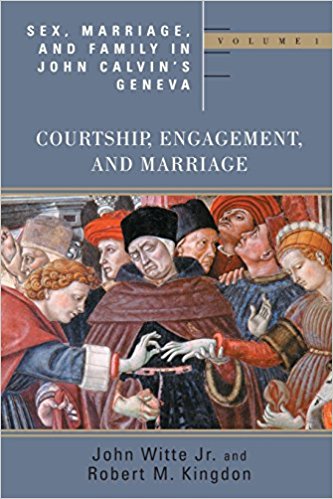 I am going to repost, with some revisions, my blog series on Kingdon and Witte’s excellent work:
  Singing & Slaying